Get in touch to send in cinephile news and discoveries. To keep up with our latest features, sign up for the Weekly Edit newsletter and follow us @mubinotebook on X and Instagram.
NEWS

Femme Fatale (Brian De Palma, 2002)
- As the Cannes Film Festival continues into its second week, visit Moirée for a live roundup of critic ratings of this year’s films, as well as roundtable podcast episodes hosted by filmmaker Blake Williams.
- More than 4,700 film professionals have signed an open letter demanding that the European Union future-proof film funding in Europe. EU Member states have debated combining the MEDIA program, the main funding source for European cinema, with a new Media+ division, which may divert film funds to other cultural areas. “It is now the time to write the next chapter of the European Cinema story, with even greater ambition, commensurate with the challenges we face,” reads the letter.
- Texas Attorney General Ken Paxton has sued Netflix for spying on users, claiming that the streamer has “quietly built a behavioral-surveillance program of staggering scale.” Paxton, currently running for the US Senate, argues that Netflix has violated the Texas Deceptive Trade Practices Act multiple times and is seeking civil fines of up to $10,000 per violation.
- More than 120 Indian filmmakers and producers have formed the Independent Filmmakers Association of India, a not-for-profit collective designed to improve visibility for the country’s independent sector. Alongside advocating for better theatrical access and distribution pathways, the IFAI will also run workshops and programs to assist emerging talent. “The idea is to create an ecosystem where independent filmmakers don’t feel isolated while making deeply personal cinema,” said actor-producer Anshuman Jha, who represented the group at Cannes.
DEVELOPING
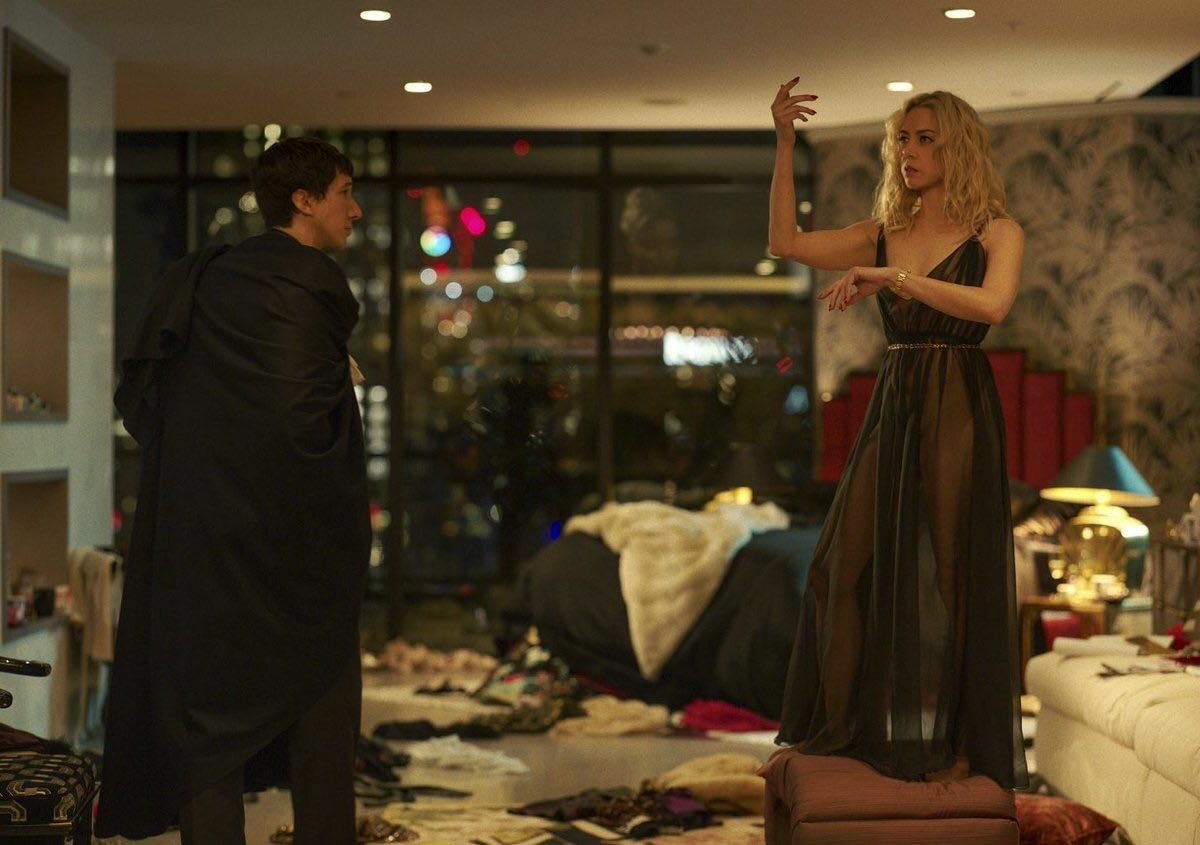
Megalopolis (Francis Ford Coppola, 2024)
- Claire Denis is set to cowrite and direct The Soap Maker, a crime thriller about Leonarda Cianciulli, a cannibalistic Italian serial killer whose story also inspired Mauro Bolognini’s Gran Bollito (1977).
- Kenneth Lonergan is set to write and direct Tomorrow Is a Drag, his follow-up to Manchester by the Sea (2016), which will star Aubrey Plaza, Adam Driver, Vanessa Kirby, and Matthew Broderick.
- Catherine Breillat is set to direct The German Cousin, an adaptation of Georges Simenon’s 1939 novel The Krull House, about a rural French community on the eve of World War II.
- John Sayles is set to write and direct the western I Passed This Way, his first film since Go for Sisters (2013), starring Amy Madigan and Chris Cooper.
REMEMBERING

Invisible Adversaries (VALERIE EXPORT, 1977)
- VALIE EXPORT has died at 85. Born Waltraud Lehner before changing her name as a rejection of patriarchal structures, the Austrian avant-garde artist was best known for her mixed-media work and provocative pieces that collapsed the distinction between cinema and live performance art. Working adjacent to the 1960s all-male Viennese Actionist art scene, EXPORT cofounded the Austrian Filmmakers Cooperative in 1968, the same year she gained renown for Tap and Touch Cinema (1968), a landmark piece that featured her taking to the streets of ten European cities wearing a mock-up of a movie screen over her bare breasts and inviting viewers to reach inside. Her reputation led to brief mainstream attention in Europe, mainly with her short film Facing the Family (1971), a critique of the bourgeoisie that aired on the Austrian Broadcast Corporation, and her debut feature Invisible Adversaries (1977), a feminist reworking of Invasion of the Body Snatchers (1956) that was widely acclaimed by international critics, such as J. Hoberman who described it as “one of the richest avant-garde features of the 1970s.” Her pioneering work across multiple mediums led to her becoming one of the first female artists to represent Austria at the Venice Biennale in 1980. In 2016, her hometown of Linz acquired her archives and opened a research center in her honor. “I hope that the young generation will closely observe the sociopolitical, cultural-political situation in their countries and take it to a global level,” she told ArtNet in 2019. “We are now in a global society so we should address these issues together.”
RECOMMENDED READING

The Devils (Ken Russell, 1971)
- “Especially minus the impositions of any censors, the complete film stands as such a loud, lavish, full-hearted protest against forces that would restrict our thoughts, acts and desires — be it the Catholic Church or a film ratings board — that its most violent excesses feel not just titillating but truthful in expression.” For Variety, Guy Lodge reports on the new 4K restoration of the complete and uncut version of Ken Russell’s The Devils (1971), which screened in this year’s Cannes Classics section ahead of an upcoming theatrical re-release.
- “Nominally a biopic, Liliane de Kermadec’s 1975 Aloïse might be more accurately thought of as an astronomical event—an interpretation bolstered by an image resembling a solar eclipse that appears during the opening credits. In essence, Aloïse is a study of two supernovae: Isabelle Huppert, then in her astral ascendence, and Delphine Seyrig, two decades Huppert’s senior and here in her mid-career annus mirabilis. In the galaxy of de Kermadec’s film, these two celestial bodies never make contact. But neither does one overshadow the other.” For 4Columns, Melissa Anderson reviews Liliane de Kermadec’s Aloïse (1975) timed to a theatrical run of its 4K restoration at Metrograph.
- “This New Wave-ish Polish gem was internationally lauded on release, but is now largely forgotten… Kawalerowicz compellingly captures the forced intimacies and claustrophobia on the train until the thrilling final act bursts onto a wider canvas with an unforgettable sequence that probes the atavistic depths of human crowd behavior.” For the BFI, Kazuo Ishiguro writes about his favorite train films ahead of his curated series Station to Station at the BFI Southbank this July.
- “Although Hamrah rails against modern inanities, his writing reflects what the eminent film scholar David Bordwell, in an essay on RogerEbert, called ‘the lightspeed punditry of the Web, which favors first-response witticisms.’ It is also symptomatic of a larger problem in contemporary discourse: rampant animus. Contrasting David Thomson with ‘the horde of cheerleading critics whose hollow praise blights the film pages,’ he appeared to recognize the dangers of the alternative impulse. He wrote, ‘Thomson alone has made bitterness a career.’ Yet one would be forgiven for thinking that Hamrah aspired to join him.” For The Ideas Letter, Leo Robson examines the highs and lows of critic A. S. Hamrah’s oeuvre.
RECOMMENDED EVENTS

Underworld (Josef von Sternberg, 1927)
- London, May 20: The Institute of Contemporary Arts presents Visible Justice: On Resistance through Image and Voice, the opening of a year-long residency from the University of the Arts London research collective that incorporates readings, a Q&A, and a screening of Walid Raad’s The Dead Weight of a Quarrel Hangs (1999).
- New York, through May 26: The Museum of Modern Art presents Teo Hernández: A Pomegranate Orchard and the Bitter Well, a series dedicated to “one of the central figures of Paris’s queer avant-garde film scene of the 1970s and ’80s.”
- Paris, May 28-31: The Cinémathèque Française presents The Great Classics of Silent Cinema as Seen by Henri Langlois, a retrospective of eight silent films revered by the archive’s cofounder, including a 35mm print of Josef von Sternberg’s Underworld (1927).
- Venice, through July 31: The Church of Sant’Antonin presents Elegy, Gabrielle Goliath's acclaimed performance project that “creates a collective space for grief, remembrance, and resistance, foregrounding mourning as an ethical and political practice” adapted for the 61st Venice Biennale.
RECOMMENDED VIEWING
- Universal Pictures presents a trailer for Christopher Nolan’s The Odyssey (2026), an adaptation of Homer’s epic starring Matt Damon as Odysseus.
- Luxbox presents a trailer for Bruno Dumont’s Red Rocks (2026), about a group of kids who compete in cliff jumping on the French Riviera. The film will have its world premiere in Cannes’ Directors’ Fortnight section on May 20.
- VisualAntics presents a trailer for Nostalgia for the Future (2026), Brecht Debackere’s experimental biography of artist Chris Marker narrated by Charlotte Rampling, which recently had its world premiere at Cannes.
- Magnolia Pictures presents a trailer for John Early’s debut feature Maddie’s Secret (2025), about a dishwasher who battles a long dormant eating disorder when she’s suddenly thrust into viral fame.
RECENTLY ON NOTEBOOK

The Misconceived (James N. Kienitz Wilkins, 2026)
- “Educate your friends and family. Loudly complain online and off. Connect the plutocratic plunder of our media system to the plutocratic plunder of health care, education, climate, politics, energy, real estate, immigration, and every other part of our failing social system. Our media system likely can’t survive further consolidation, but the public can be persuaded: we care about stories and we rely on good information systems.” Andrew DeWaard surveys the Hollywood’s consolidation crisis in light of the impending merger between Paramount and Warner Bros. Discovery.
- “I had a lot more fun with another opener, Teenage Sex and Death at Camp Miasma,which kicked off this year’s Un Certain Regard. Jane Schoenbrun’s third feature was an early festival standout, and in my book something of a revelation—that rare queer film that doesn’t qualify as such purely by virtue of the kind of characters that populate it but earns the descriptor in a much more fundamental sense: it’s a work that relishes in subverting conventions and genre tropes, beckoning you into a universe that’s decidedly, refreshingly weird.” Leonardo Goi reports from the Cannes Film Festival to provide first reactions on a few highlights.
- “This year marked the ninth and final year of departing artistic director Emilie Bujès’s tenure; I have seen seven of those editions, starting with tapping in online during the COVID spring of 2020, and they’ve all expanded my understanding of current global cinema, leading me to consistently good work that, regrettably, rarely seems to make the leap to American festivals and is thus worth flying to Switzerland for.” Vadim Rizov reports from Visions du Réel and the cinema of displacement that defined this year’s lineup.
- “In a way, the movie is kind of a workshop. It’s fundamentally experimental in that we just didn't really know what the outcome would be. But that's not in opposition to having narrative consistency or story and all of that. A lot of the feedback we received was like, “I think the script is pretty good.” And that almost gave me license to experiment in this way, because at the end of the day, the skin of it is all still hanging on a cohesive narrative.” Jordan Cronk interviews James N. Kienitz Wilkins about his new film The Misconceived (2026), its multi-part production process, and the state of independent cinema.
WISH LIST

The Narrow Margin (Richard Fleischer, 1952)
- Richard Fleischer: Journeyman, Jason A. Ney’s new biography of the eclectic Hollywood director, is available to purchase.
EXTRAS
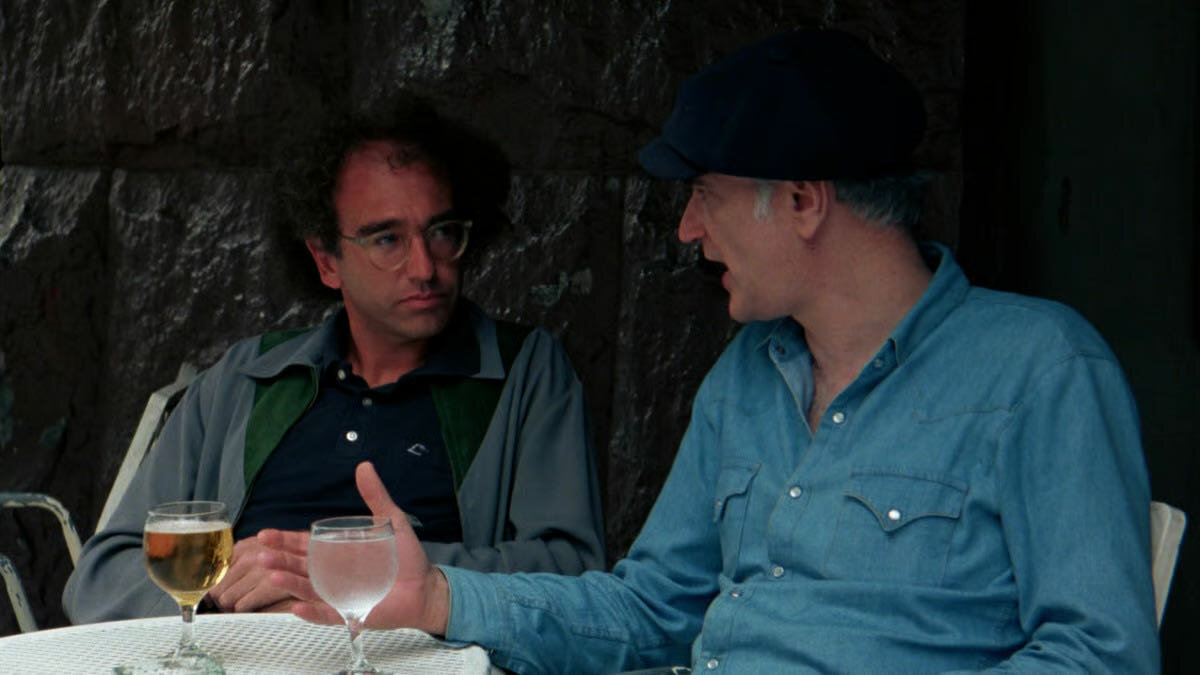
Can She Bake a Cherry Pie? (Henry Jaglom, 1983)
- Excerpts of Larry David’s unproduced script Prognosis Negative, a title he later repurposed for a running gag on Seinfeld (1989–98), are available to read.