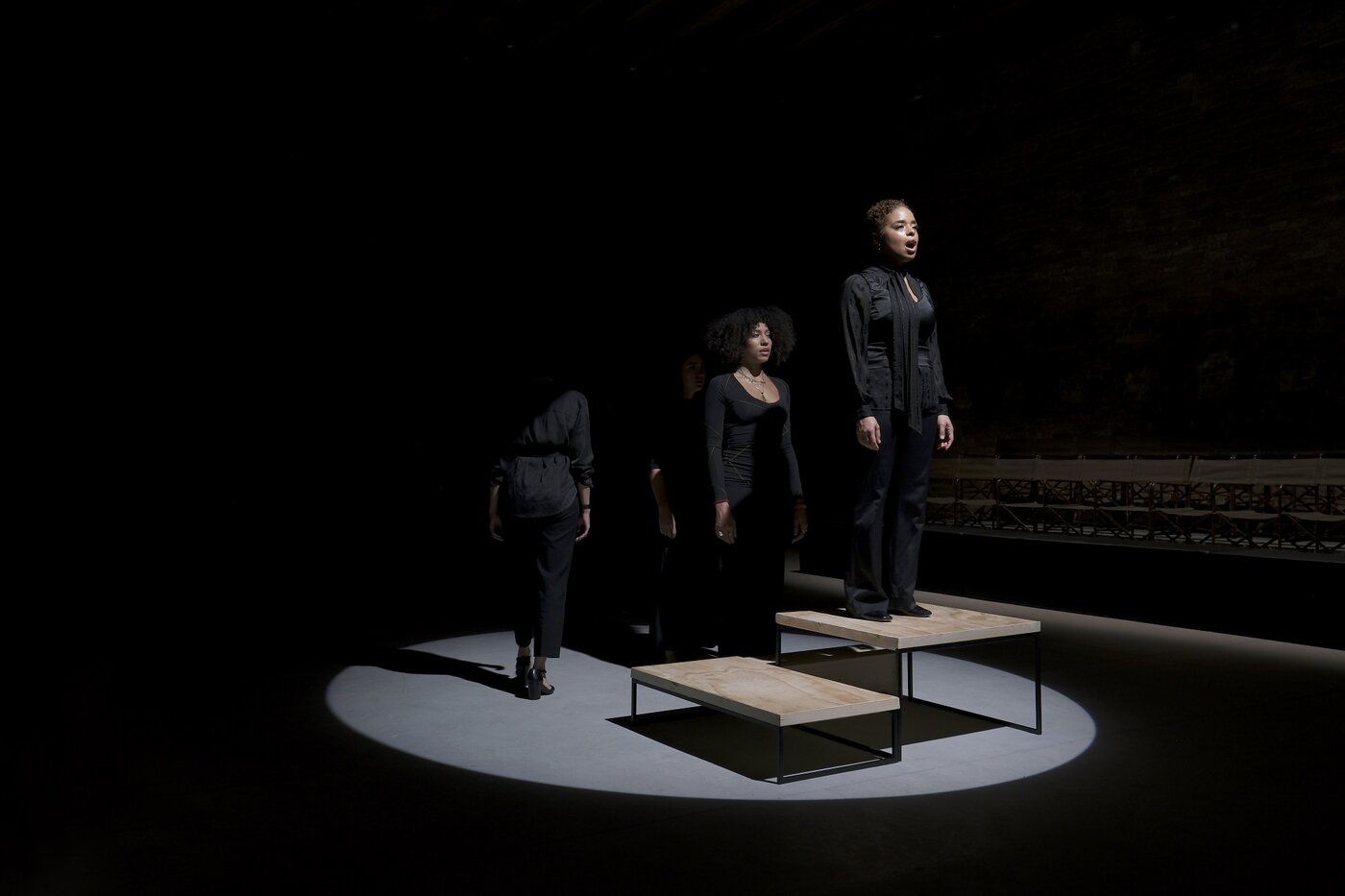
Elegy - for two ancestors (Gabrielle Goliath, 2024), performance, Sale d’Armi, Arsenale, Venice. Photo by J Macdonald.
The 61st edition of the Venice Biennale opened in the middle of a storm—both literally and metaphorically. Plagued by rain and lightning in its pre-opening week, the so-called “Olympics of the art world” was still reeling from the sudden death at the age of 57 of its selected curator, the inimitable and beloved Cameroonian museum director Koyo Kouoh. Before her passing, she selected a committee of close friends to finish her project, leaving behind an artist list and notes for an exhibition titled In Minor Keys. In her curatorial statement, she put forth her vision for the show:
“These are the cues for an exhibition; an exhibition tuned in to the minor keys; an exhibition that invites listening to the persistent signals of earth and life, connecting to soul frequencies. If, in music, the minor keys are often associated with strangeness, melancholy and sorrow, here their joy, solace, hope, and transcendence manifest as well. In the minor keys, sound and sensation are grounding, they hold the cadences, melodies, and silences of resonant worlds that gather and create together a polyphonous assembly of art, convening and communing in convivial collectivity, beaming across the void of alienation and the crackle of conflict.”1
Appointed to organize the Biennale’s centerpiece exhibition spread across the Biennale Foundation’s two fairgrounds, the Giardini and Arsenale, Kouoh’s show intended to amplify the “minor keys,” described as artists with roots in the Global South, often overlooked and united in their belief that art can lead to radical solidarity and community-building.
However, controversy and chaos were constant in the months leading up to the opening, which many attributed to the Biennale Foundation’s arcane infrastructure consisting of a single main exhibition split across the Giardini and Arsenale, a variable number of “national pavilion” exhibitions under the jurisdiction of a country’s cultural ministry or state department, and Biennale-approved “collateral” exhibitions presented by various international arts institutions—not to mention the numerous rogue exhibitions planned to coincide with the Biennale’s opening. With this volatile clash of international power players and an arts organization without the authority to override them, there were wide-ranging calls among participating artists to ban Israel’s national pavilion in response to the country’s genocidal campaign in Gaza and Lebanon; an uproar from the European Union regarding Russia’s first national pavilion since the 2022 invasion of Ukraine; a bungled selection process for the American Pavilion by Trump’s cronies; and the mass resignation of the jury in charge of awarding the prestigious Golden and Silver Lions following blowback against their intention to “refrain from considering those [national pavilions] whose leaders are currently charged with crimes against humanity by the International Criminal Court.”2
Sloshing through puddles in the grounds of the Giardini and Arsenale in early May, there was certainly a sense that something was amiss—that the ideas and ideals put forth by Kouoh, her curatorial team, and the selected artists were in direct opposition to an infrastructure that allows for soft power maneuvers and statecraft by nations that are more interested in silencing the minor keys than listening to them.
IN MINOR KEYS
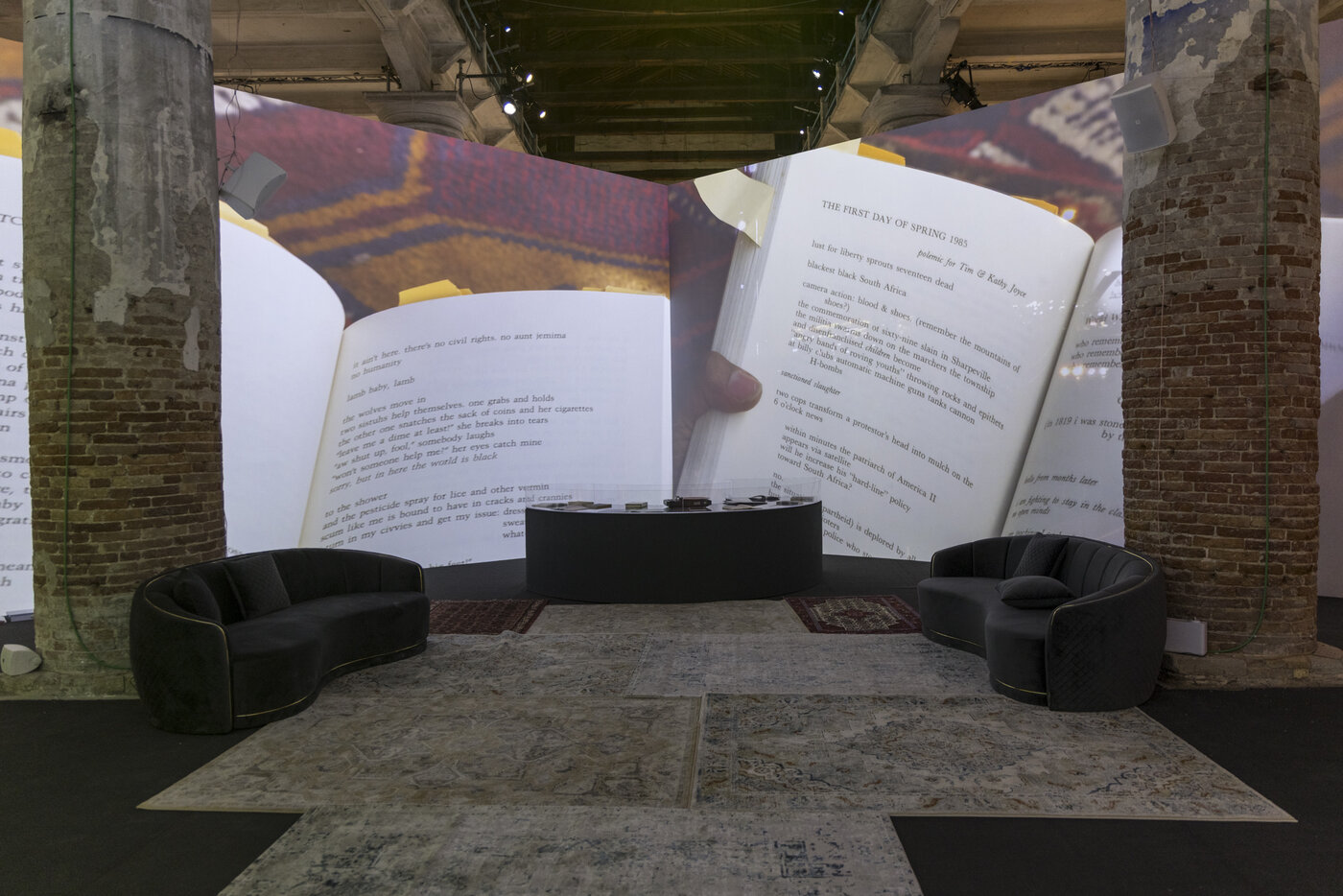
The Wanda Coleman Songbook (Cauleen Smith, 2024). Installation view.
111 participating artists and collectives from around the world. Moving-image work in the Giardini is sparse, often relegated to plain documentation of artists and writers such as Issa Samb, a key figure in Senegal’s experimental art scene and a personal mentor to Kouoh, and the artists of the Nairobi Contemporary Art Institute working in their studios. The only other video works that appear in the Giardini are those of two American art groups: fierce pussy, a five-person collective that uses art as a tool for queer and feminist liberation, and Denniston Hill, an artist residency in New York’s Catskill Mountains. Constructed from extant works of past residents such as Nikita Gale, Autumn Knight, and Lotus L. Kang, Denniston Hill’s founders craft an “exquisite corpse” of works on paper, sculpture, text, and video that speak to the collective power of the residency.
In the Arsenale, however, video is key to the infrastructure of the exhibition, anchoring an industrial maze of galleries with rooms dedicated to a single moving-image work. A four-channel video that practically opens the exhibition, American artist Cauleen Smith’s The Wanda Coleman Songbook (2024) is a love letter to the eponymous late poet and her and Smith’s shared hometown of Los Angeles. Smith portrays the landscapes of the city’s neighborhoods while a seven-song soundtrack featuring Black composers reinterprets Coleman’s prose. To complete the viewing experience, a Persian-style rug is laid out underfoot, a record player turns nearby, and the earthy scent of Griffith Park is diffused into the space.
Landscapes, both urban and rural, figure widely in other video works, often signifying the changes wrought by colonial powers. French photographer and filmmaker Florence Lazar has two pieces in In Minor Keys. The more impressive of the two, It’s All Thanks to Bad Weather (2024), documents the shoreline of Martinique’s Anse Bellay, a historic grave site for enslaved people that was destroyed by Hurricane Dean in 2007. Lazar follows a group of concerned citizens rallying against a clean-up plan proposed by the French government that would exhume these remains and categorize them as archeological artifacts rather than the bodies of the deceased. By including the natural beauty of the land and the everyday moments of the Martinican people, Lazar reinstates dignity for the inhabitants of the island, living and dead. From one Caribbean territory to another: Sofía Gallisá Muriente of San Juan, Puerto Rico, makes films-within-films by recording projections of Super 8 and 16mm films onto various environs on her native island. Últimas luces/Last Lights (2024) shows exposed celluloid projected onto the façade of her late grandmother’s home, recalling lost and unreliable memories of family and homeland. This exploration into the rippling effects of colonialism is translated to monumental size in French-American artist Éric Baudelaire’s Death Passed My Way and Stuck This Flower in My Mouth (2021), a kinetic five-channel portrait of a Dutch flower warehouse through which commodities travel from African farms to international markets. Edited with utmost precision by Claire Atherton, whose credits include films with Chantal Akerman and Wang Bing, the installation captures the tension between the real and industrial, or more accurately, the ways that capital subsumes our natural resources.
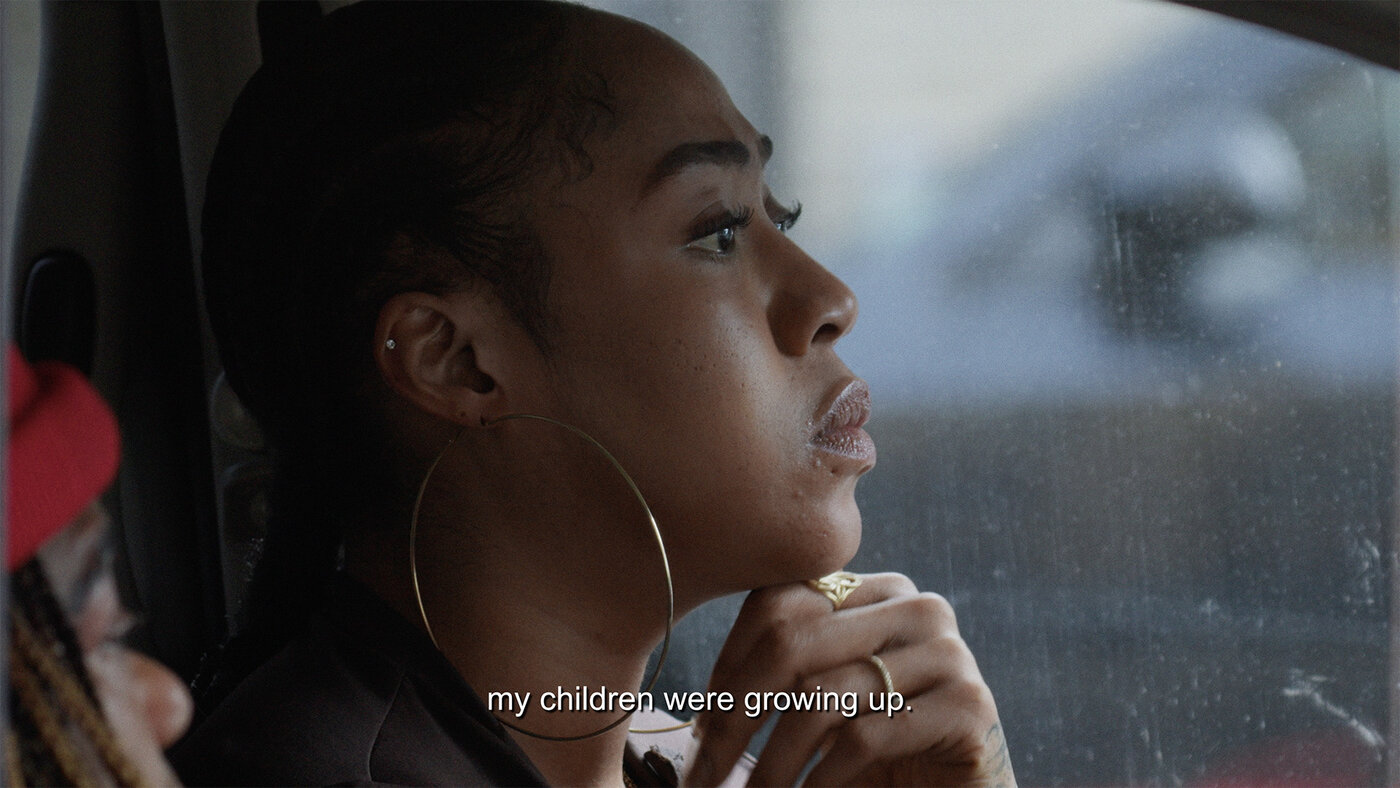
Mercurial New York (Rose Salane, 2025-2026). Courtesy of the artist and Carlos/Ishikawa, London.
Two of In Minor Keys’ most high-profile artists, Tuấn Andrew Nguyễn and Tiona Nekkia McClodden, eschew the experimental for more structured narratives, yielding differing results. McClodden’s multi-media installation is centered on two videos RUINOUS, CHANNEL I and CHANNEL II (both 2026) which feature McClodden playing a semi-autobiographical character. While one of these stories continues McClodden’s long-time artistic engagement with the BDSM community, the other is inspired by Percival Everett’s novel So Much Blue (2017) and the central character’s desire to destroy one of her paintings. In the crowded exhibition room of the Arsenale, it is difficult to give McClodden’s work the undivided attention it deserves, but the artist’s striking visuals rendered in both an inky black-and-white and full color shine through, even when its themes of control in one’s artistic practice and relationships feel sadly muddled in its surroundings. A regular on the international biennial circuit known for his experimental films chronicling the Vietnamese diaspora, Nguyen presents Ñi demoon ñoo dellusi (Those Who Left Are Those Who Return, 2026), a documentary on the Senegalese-Vietnamese community in Dakar, which emerged following France’s military actions in then-Indochina, and its Robin Hood-esque folk hero Bouba Chinois. The filmmaker weaves together interviews of the now-elderly Bouba with photographs of his family, including his Vietnamese mother. Although a showcase for Nguyen’s mastery of camerawork and storytelling, Ñi demoon ñoo dellusi’slinear narrative is the most literal interpretation of the mission of In Minor Keys, making it feel somewhat lackluster in comparison to Nguyen’s previous work, which incorporated more formally ambitious visuals and a heady dose of the spiritual.
Whereas such straightforward work fell flat, New York-based Rose Salane’s film Mercurial New York (2025-2026) best represents how to showcase the “minor keys” of the world in a way that feels both revelatory and heartfelt. Salane’s camera captures a series of vignettes in medias res showing New Yorkers caught in conversation across the five boroughs. Told in 16 different languages to represent the city’s diverse immigrant population, it includes a couple deciding whether to have children, people discussing politics, and phone calls between strangers with no clear resolutions or connections, making the audience benevolent eavesdroppers. By watching these intimate moments, we are invited into their lives—their hopes, fears, and what they must do to simply get by in a metropolis like New York. Kouoh’s In Minor Keys is at its best in this register, where audiences are required to listen to voices normally drowned out by the roaring conflict of the world.
NATIONAL PAVIOLIONS (OFFICIAL AND OTHERWISE)
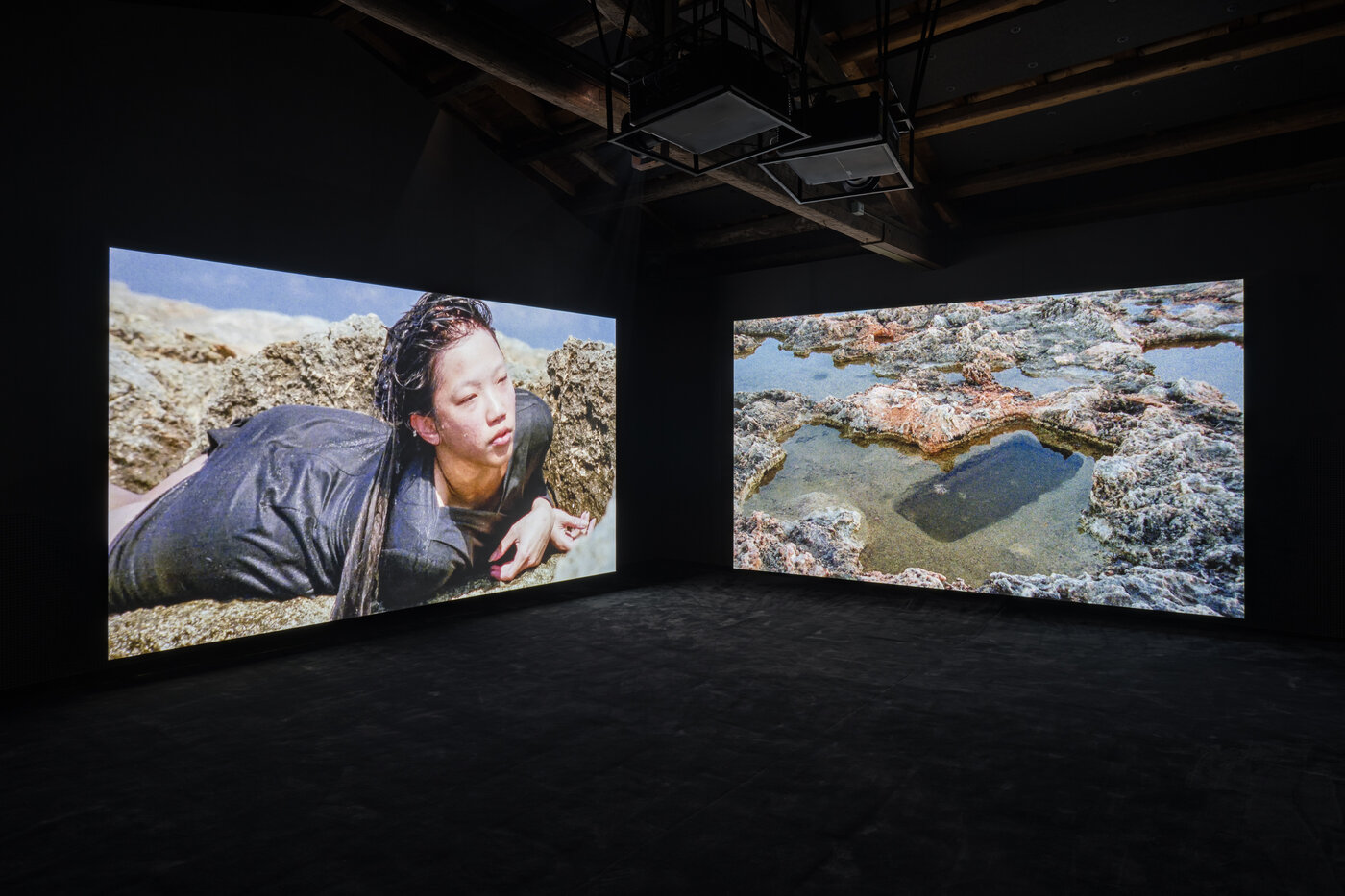
animism sings anarchy (Eglė Budvytytė, 2026). Installation view.
Standing in immense contrast to In Minor Keys are the 100 official national pavilions—independently commissioned, curated, and funded by the participating country—spread across the Giardini, Arsenale, and the whole of the city, each containing an argument of what its country’s national identity is—or, in some cases, could be. The Czech and Slovak Pavilion, its very name a suggestion of the outdated pavilion structure, features the artists Jakub Jansa, Alex Selmeci, and Tomáš Kocka Jusko and their joint project The Silence of the Mole (2026). While Selmeci and Jusko (working under the joint name of Selmeci Kocka Jusko) present a series of totemic sculptures, the video centerpiece of the show features Mr. M, an old, exhausted actor who has portrayed an anthropomorphic mole in a fictional children’s television show for decades. Mr. M’s grip on reality is fragile, and he is unable to differentiate his real life from his life onscreen. A representation of Czech and Slovak collective memory, Mr. M is subsumed in anxiety, representing deep fears regarding a cultural—and therefore national—future.
The Philippines Pavilion, too, concerns memory as a politically charged motif. Jon Cuyson’s Sea of Love/Dagat ng Pag-ibig features the multi-channel Sea of Echoes (2026), a collection of non-linear stories that show Filipino life and history from four perspectives: a sailor, his trans lover, his mother, and the humble mussel. Set in the fishing city of Cavite City, these characters’ lives are shaped by what the artist calls “mussel thinking,” an understanding of the world informed by ecological conditions rather than capital and nationhood.3 The Lithuanian Pavilion also used memory as a politically charged motif. Performance and visual artist Eglė Budvytytė’s animism sings anarchy (2026) is inspired by the work of late Lithuanian anthropologist Marija Gimbutas and her scholarship into Neolithic matriarchal societies. Budvytytė splits the three-channel film between two narratives: one set in a mountainous landscape in Apulia where Gimbutas studied an ancient water cult, and another among the ancient artifacts of Rome’s Museo della Civiltà. In both settings, the dancers interact with their surroundings in a manner that appears ritualistic; they quiver, flinch, and writhe around as if experiencing the spiritual ecstasy of their Neolithic foremothers. In their trance, the dancers suggest a shared knowledge between the old and the new, and, crucially, a way forward by adapting the structures of ancient civilization to today’s world.
Other pavilions eschew a strictly national context by looking at the way moving images shape our cultural and political understandings. In the cheekily titled Things to Come, photographer and Denmark Pavilion artist Maja Malou Lyse uses the visual tropes of pornography—fetish wear, a cartoonish emphasis on the actors’ breasts, curves, and rears, and cam-girl POVs—to explore fertility and reproductive health. Inspired by a study that showed increased sperm motility in subjects regularly consuming online porn, Lyse, in partnership with the “post-internet” collective DIS, depicts real-life porn stars delivering a satirical, highly stylized public service announcement about male reproductive health in a sperm bank. Best encapsulated by a quote from one of Lyse’s performers: “I need to tell you something important, so I’m going to take my clothes off.”
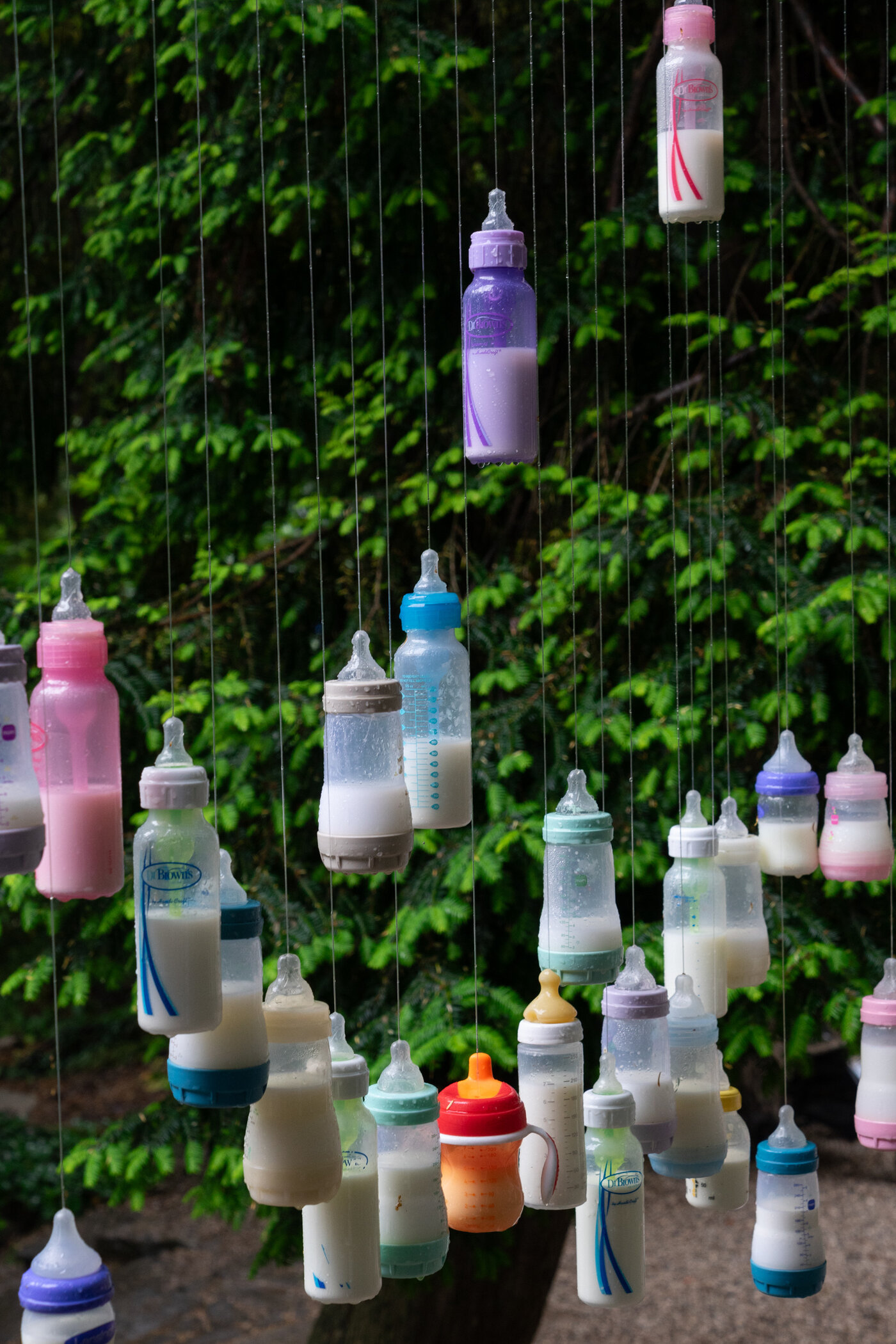
Grass Babies, Moon Babies (Ei Arakawa-Nash, 2026). Installation view. Photo by Luca Zambelli Bais, courtesy of La Biennale di Venezia.
Also drawing on childbirth, the Japan Pavilion’s Ei Arakawa-Nash draws from his experience as a new father to infant twins in the installation Grass Babies, Moon Babies (2026). The pavilion space is covered with life-size baby dolls, which viewers are invited to dote on as they walk through the exhibition. Featuring text-based works that encourage would-be parents worried about the future, Arakawa-Nash’s meditation on parenthood as a queer immigrant is radically optimistic at a time when gay rights both in the United States and internationally are being stripped away and the apocalypse—environmental, nuclear, or otherwise—appears to be nigh. As Lyse also posits in Things to Come, parenthood in Arakawa-Nash’s view is not immune from social and political contexts. The video Twins’ First Films (2026; made in collaboration with Saito Reiji) shows Arakawa-Nash and his infant children watching their first movies—a series of nine Japanese diasporic films that includes titles by Hou Hsiao-hsien and Fujimoto Akio—on an iPad. The babies crawl over the artist’s lap, grab the iPad, coo, and gurgle, showing a wide range of disinterest and engagement with the moving image. Even in infancy, imagery is inescapable and ingrained with political messaging.
In the aftermath of sculptor Alma Allen’s poorly organized and critically maligned American Pavilion, I heard many writers and curators say that this year’s real American Pavilion was Fondazione Prada’s collateral exhibition Helter Skelter, an ambitious showcase focused on appropriation in the art of Arthur Jafa and Richard Prince. Jafa and curator Nancy Spector brought all of the artist’s best-known video work to the palatial Ca’ Corner della Regina: 2018’s The White Album, which won Jafa the Biennale’s Golden Lion in 2019, is a razor-sharp critique of whiteness and its creation through moving image, and his found-footage collage Love Is the Message, the Message Is Death (2017) remains inarguably one of the masterworks of the 21st century. One of Jafa’s newest videos, BEN GAZARRA (2024; originally titled BG), reimagines the climax of Scorsese’s Taxi Driver (1976) by recasting Iris’s pimp Sport, originally played by Harvey Keitel, and his associates with Black actors. Jafa makes an incendiary proposition by reframing one of cinema’s unimpeachable classics in a way that forefronts its hidden yet problematic racial politics, but BEN GAZARRA is the work that best encapsulates both Jafa and Prince’s shared artistic thesis of exposing America’s nasty underbelly through its cultural detritus.
If Helter Skelter is colloquially considered a “national pavilion,” it is worth discussing two other collateral exhibitions-cum-“unofficial national pavilions,” both of which have been blocked from participation by political behemoths strong-arming a comparatively weak Biennale Foundation. Following their demotion from official pavilion to “collateral event” in 2003 due to diplomatic pressure from China, Taiwan and the Taipei Fine Arts Museum present Screen Melancholy, an ambitious work of auto-fiction from artist Li Yi-Fan.4 An animated video featuring Yi-Fan’s double—a pale, mischievous cryptid crawling around a darkened artist’s studio—teaches the audience how to “create a video” featuring creepy sight gags and quips about content farms, the role of the artist, and the entire nature of this pavilion, which had been punted to the tourist epicenter of Piazza San Marco. Unlike Taiwan, South Africa has had a continued presence in Venice since 1993 following a decades-long ostracization from the event during apartheid. In 2025, internationally acclaimed artist Gabrielle Goliath was announced as the nation’s representative, only to have this position revoked months later following complaints that Goliath’s projectwould include a tribute to the victims of Israel’s genocide in Gaza. Defiant in the face of blatant government censorship, Goliath instead took residence in a local church to stage Elegy (2015–), a sobering video installation that memorializes victims of gendered violence, rape culture, and genocide in South Africa, Namibia, and, yes, Palestine. Across eight tombstone-like plinths with screens, small groups of women take turns stepping onto a raised platform and singing a single note until their breath gives out, at which point another woman steps up and begins singing. Originally staged as a live performance, these videos repeat, excluding a single empty screen in memory of murdered Gazan poet Hiba Abu Nada. In its immense grief over those killed by empires and their attendant misogyny, Goliath’s Elegy positions mourning as a politically powerful tool by showing the enduring power of a collective united in sorrow and righteous anger, represented by each member of the choir dutifully stepping in once their comrade is out of breath. Whereas this chapel sings with hope amid tragedy, the South African pavilion in the Arsenale is dark and empty. Its silence is a deafening reminder of the cowardice of nations and the inability of the national pavilion structure to meet our current moment.
COLLATERAL EXHIBITIONS
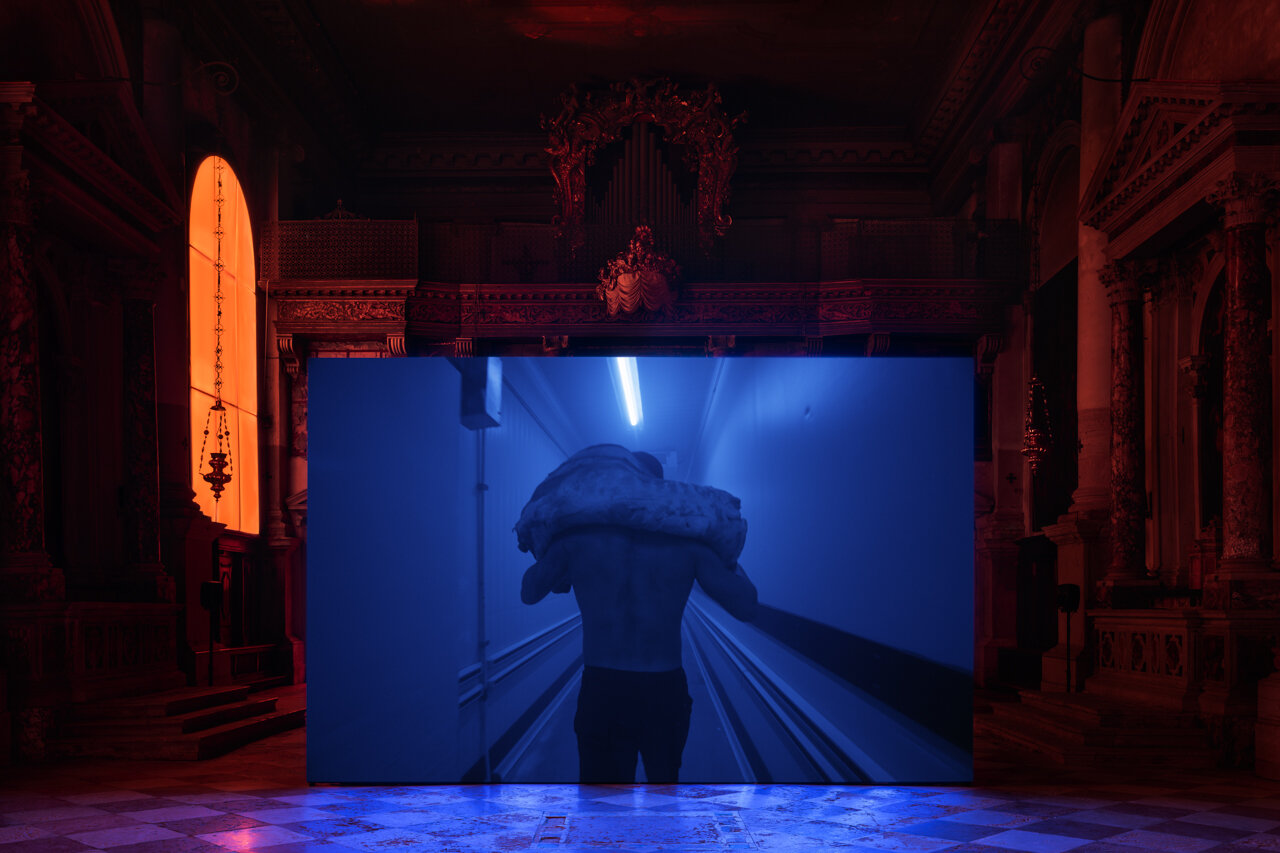
Baby I'm Yours, Forever (Janis Rafa, 2026). Installation view.
Elsewhere in the Venetian lagoon, private collections and non-profits capitalize on this moment with collateral exhibitions that, like the presentations of Jafa, Yi-Fan, and Goliath, are thematically and administratively separate from the Biennale. Berlin’s LAS Art Foundation and Helsinki’s Amos Rex joined forces to present Natasha Tontey’s The Phantom Combatants and the Metabolism of Disobedient Organs (2026), a campy, high-tech video installation that reimagines the story of Len Karamoy, a Minahasan freedom fighter in the 1958 Permesta Rebellion against the Indonesian armed forces. Tontey—who is also Minahasan—crafts a fantasia of B-movie aesthetics, Indigenous religious rituals, and 3D animation that elevates a story of liberation to exuberant heights.
The highlight of the collateral exhibitions—if not the entire Biennale—is Canicula, a group show staged by Rome’s Fondazione In Between Art Film. The final exhibition in a series of three consecutive collateral presentations in Venice, Canicula commissions eight moving-image artists to create new works for the Complesso dell’Ospedaletto, an abandoned building that previously served as both a place of worship and a hospital. The exhibition’s artists address the distortion of time and the pressure of one’s surroundings, encapsulated by works such as P. Staff’s Terminal Lucidity or Maya Watanabe’s Jarkov (both 2026) that attack the senses with flashing lights and abstracted images. The exhibition can only be viewed on a set path that requires audiences to see each film in the order dictated by the curators, beginning in an ornate chapel with Janis Rafa’s Baby I’m Yours, Forever (2026), which shows a homoerotic rave set in a slaughterhouse, and ending in the sparse rooms of the building’s former retirement home with a multi-channel video Affirmations (2025–26) by Ukrainian duo Roman Khimei and Yarema Malashchuk. The church’s frescoed concert chamber features a new multi-channel work from artist and forensic audio investigator Lawrence Abu Hamdan’s 450XL: The Story of Fugitive Sound (2026), which through fragments of sound, video, and eyewitness testimony deconstructs an official report by Serbian and Russian authorities on a March 2025 “sonic attack” on a vigil in Belgrade. Set against a slowed, dirge-like remix of DeBarge’s “All This Love,” Yuyan Wang’s Boring Billion (2026) distorts the lines between human and technology in a fragmented series of clips showing mechanical production, from crude internet clips to sleek productions capturing assembly lines. Wang’s video culminates with shots of a robot—one that, fully assembled, appears eerily human. Despite the bloodshed and conflict throughout Canicula, it is this shot of the blank-faced, perfect robot that lingers as an omen of the future. Separated from the politics (literal and otherwise) of the Biennale, these exhibitions feel freer, more willing to experiment than those in the Giardini and Arsenale—and are all the better for it as a result.
The 61st Venice Biennale is loud—a mess of voices, ideologies, and images fighting with each other to be heard. A byproduct of competing institutional and international politics, the main exhibition and the national pavilions are often in conflict with one another, allowing official and unofficial collateral exhibitions around the city to steal the spotlight. Despite the best attempts—and at times, successful ones— by Koyo Kouoh and her team to make an exhibition that shows the beauty, resilience, and pain of global strife, the messages of In Minor Keys are drowned out by the din of nations either struggling to understand their identity or enforcing their will upon others. The artists using video and installation across this Biennale are making important statements that deserve your attention. It is doubtful, though, that you will actually hear them amid the noise.
1. Koyo Kouoh, “In Minor Keys: Introduction–Part I”
2. Zoe Butt, Elvira Dyangani Ose, Solange Farkas, Marta Kuzma, and Giovanna Zapperi, “Statement of Intention by the International Jury of the 61st International Art Exhibition ‘In Minor Keys’ of La Biennale di Venezia”
3. Jon Cuyson, “Jon Cuyson on Representing the Philippines at the 61st Venice Biennale” in ArtReview (Published May 27, 2026).
4. Vivienne Chow, “When Taiwan Abruptly Canceled Plans for Its Venice Biennale Exhibition, Its Organizers Turned to History for a Solution,” in Artnet (April 26, 2022).