
Illustrations by Antonio Carrau.
Notebook is covering the Locarno Film Festival with a cycle of close reads written by the participants in the Critics Academy.
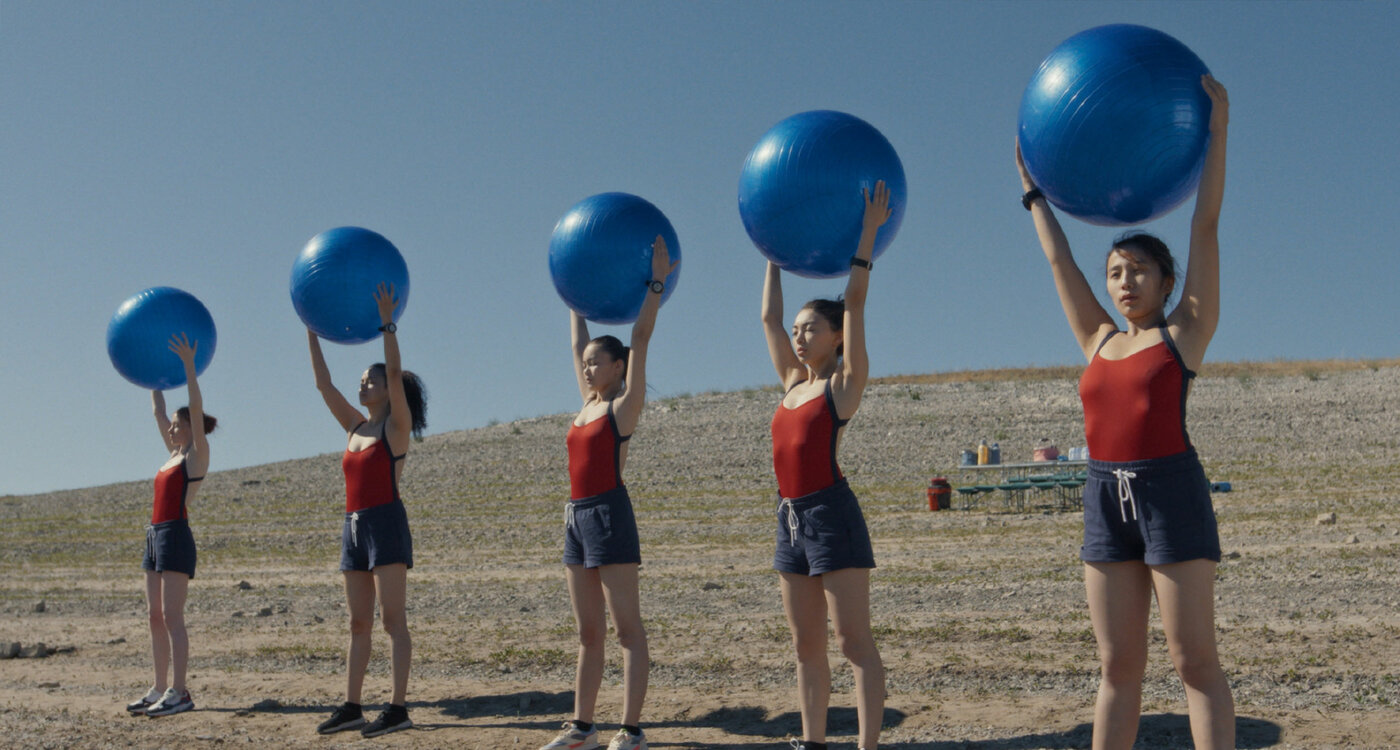
Becoming (Zhannat Alshanova, 2025).
When a college lecturer and her student share an eager kiss in Zhannat Alshanova’s History of Civilization (2020), it marks the beginning of something electric, transgressive even—an impossible act for a tenured professor. When I watched the film for the first time, the scene sparked a more general realization: I am not used to seeing Kazakh people kiss onscreen.
In Kazakhstan, and Central Asia more broadly, depicting intimacy in cinema remains a fraught endeavor; explicit sex scenes—unthinkable. Female desire, in particular, is still a cultural taboo, constrained by the traditional veneration of chastity, the remnants of Soviet-era austerity, and the state’s tight grip on cultural production. Chastity is upheld through the concept of uyat, simply translated as “shame”; in reality, it functions as a powerful social mechanism, regulating behavior and reinforcing gender and sexuality norms. A woman having a child on her own—uyat; a girl wearing a short skirt—uyat. A couple seeking a divorce—uyat for all families involved.
Lately, however, the concept has been reexamined, particularly in cultural and academic contexts, where uyat is increasingly seen as a tool of patriarchal control. In the last ten years, intimacy has been at the core of many films by Central Asian female directors, such as Assel Aushakimova’s Welcome to the USA (2019)—notably the first film to center a queer Kazakh woman—and Malika Mukhamejan’s Longer Than a Day (2024). These filmmakers portray longing and lust delicately, through silences and interstices. Alshanova’s Becoming (2025), which premiered in the Concorso Cineasti del Presente at the Locarno Film Festival, poses a related question: How can filmmakers render female sexual desire with greater nuance in a country where its depiction is usually very subdued, if not outright prohibited?
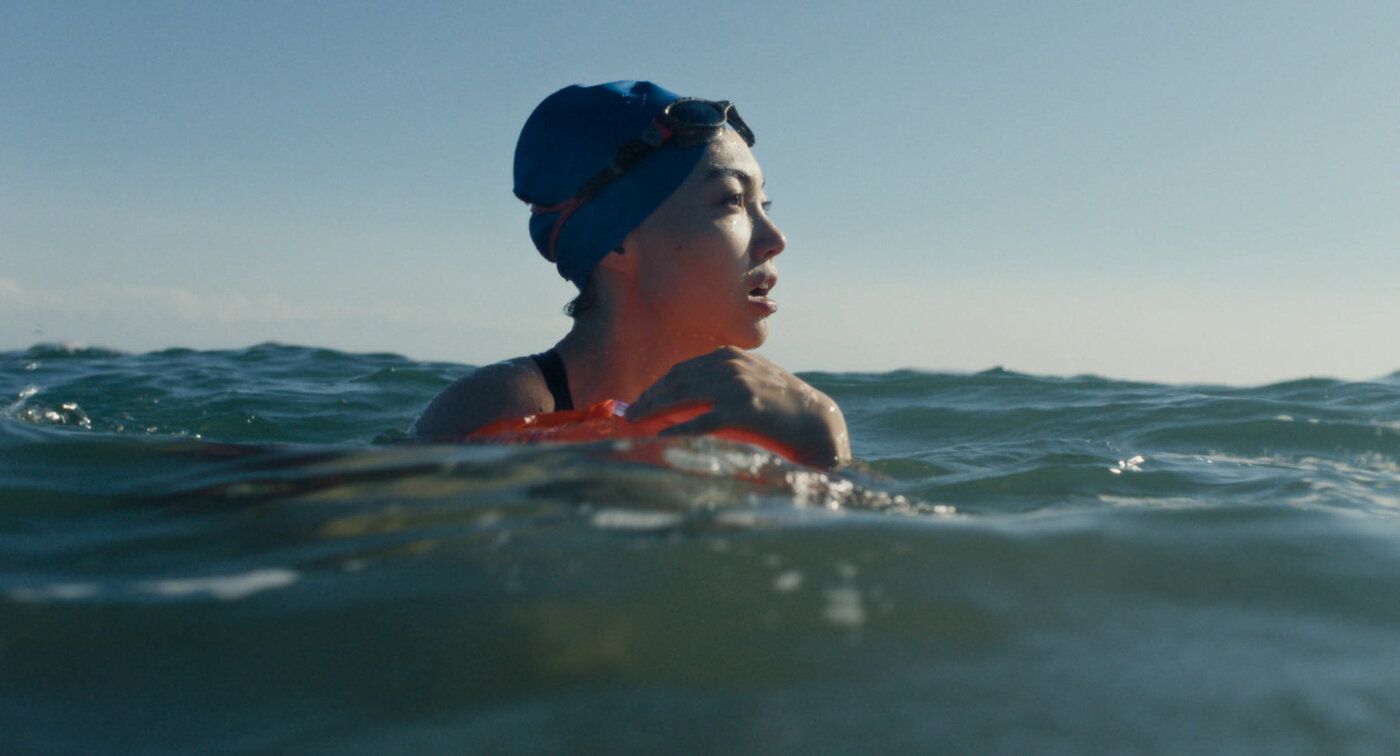
Becoming (Zhannat Alshanova, 2025).
In her short films, Alshanova explores the mechanics of desire in older women vis-à-vis younger men. The thirty-something college professor from History of Civilization is on the precipice of a major transition, a planned move to London, when she kisses her student. Paola, the protagonist of Paola Makes a Wish (2019), is a cook in her forties, who, after eavesdropping on her colleagues’ sexcapades, sets off on a dalliance of her own. End of Season (2018) sees a widow in her fifties, a Breillat-esque figure but bottled-up and demure, slowly open herself up to a younger man’s advances. Notable recent works exploring “middle-age coming-of-age,” like Mia Hansen-Løve’s Things to Come (2016), Catherine Breillat’s Last Summer (2023), and Halina Rejn’s Babygirl (2024), center middle-aged women in transgressive age-gap relationships with younger men—reversing traditional structures and challenging enduring taboos around female desire and power. Alshanova, however, always draws the curtain right when her protagonists come to a moment of deep self-realization; their entanglements enable their leaps into the unknown. Intimacy here becomes a means to an end, and that end, Alshanova suggests, is beyond the object of desire.
In Becoming, Alshanova’s long-awaited feature debut, she turns back the clock to focus on a teenage protagonist. On the surface, the film is a coming-of-age story about a neglected seventeen-year-old girl, Mila (Tamiris Zhangazinova), who becomes infatuated with Vlad (Valentin Novopolskij), the manager of an open-water swim team. Her awakening follows the expected beats of the genre, but Vlad gradually comes to occupy a peripheral presence. Alshanova is less interested in whom Milla desires than in how and why. Coming-of-age films have historically explored the transgressive potential of intimacy, steeped in Western traditions of the Bildungsroman and Éducation sentimentale. With Becoming, the genre is situated within a larger, explicitly Kazakh cultural tension—between repression and self-realization.
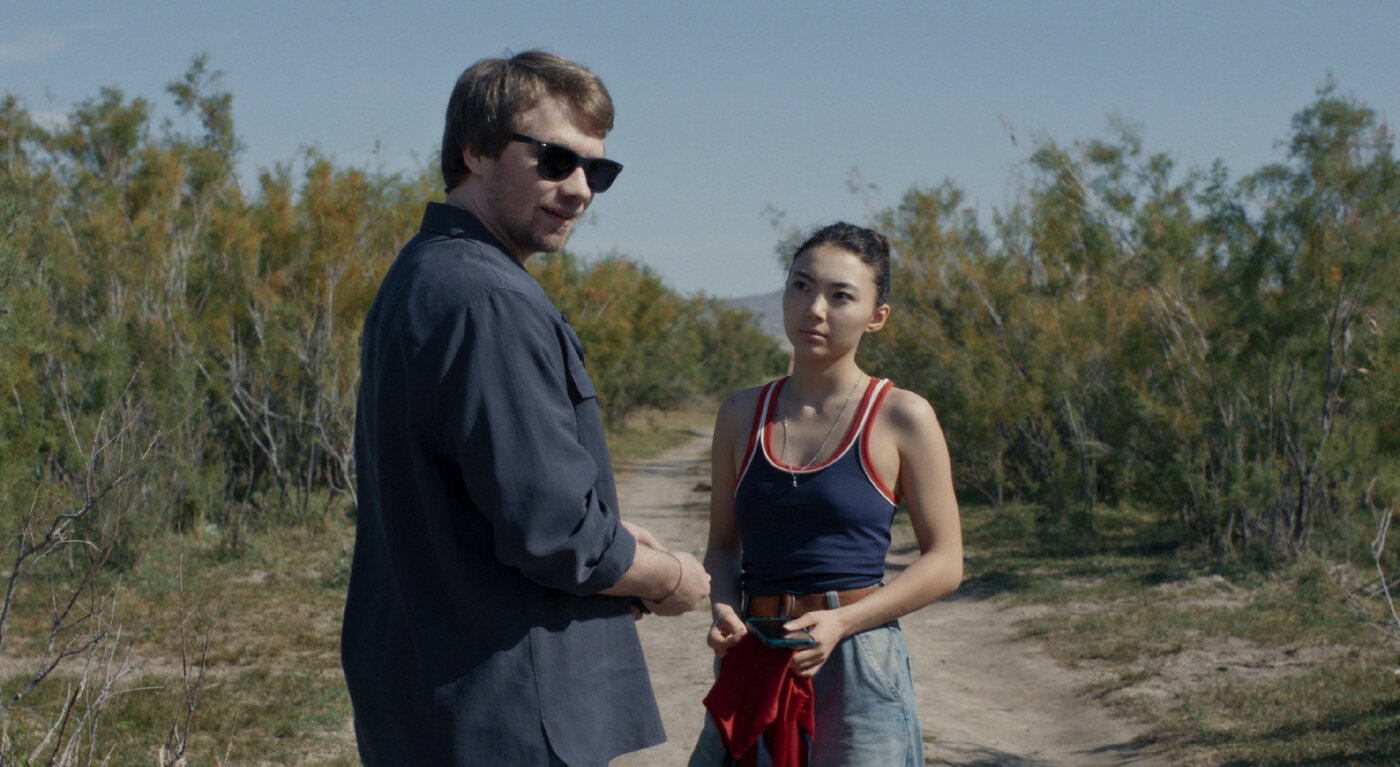
Becoming (Zhannat Alshanova, 2025).
Contrary to her shorts—in which she renders yearning visually, through ardent close-ups—Alshanova outlines the contours of Mila’s longing through sound. A diegetic soundscape precedes her first encounter with Vlad: The thudding of suitcases being dragged upstairs as Mila’s family arrives at a resort; the staccato clicking of her sister’s button-mashing. In the key “meet-cute” scene, when Mila sees Vlad in his element—lingering by the swimming pool, a gray eminence of sorts—music enters the film. Emil Sana’s minimal, ambient score gently crescendos as veteran cinematographer Caroline Champetier zooms tightly on Mila’s enchanted face. The young woman’s contradictory feelings of reserve and yearning are underscored by the emotional restraint of Sana’s music. “It’s too shaky,” comments Vlad on Mila’s breathing when she demonstrates her swimming technique to join the team; he taps rhythmically on a steel bar: “It should be like this.” He might as well be commenting on the girl’s burgeoning desire to get to know herself.
But bodily desire is not Alshanova’s sole preoccupation; she examines its structure to probe deeper moral questions. Here, the film plunges into darker waters: the conflict between Mila’s conscience and self-actualization. To join the main swim team for an upcoming competition, Mila bribes the coach. The latter accepts the money, but kicks out Mila’s friend, not the girl Mila had thought would be let go. Champetier’s camera registers the pangs of doubt on Mila’s face as she realizes the repercussions of her decision, and here, Becoming finds its strongest footing: It is able to weave together desire, shame, and growing pains. For me, as a Kazakh woman, it is not kissing a man onscreen that most powerfully suggests uyat, but bribing one’s way to the top. While uyat helps maintain social facades, it falls short of igniting a true ethical reckoning with corruption.