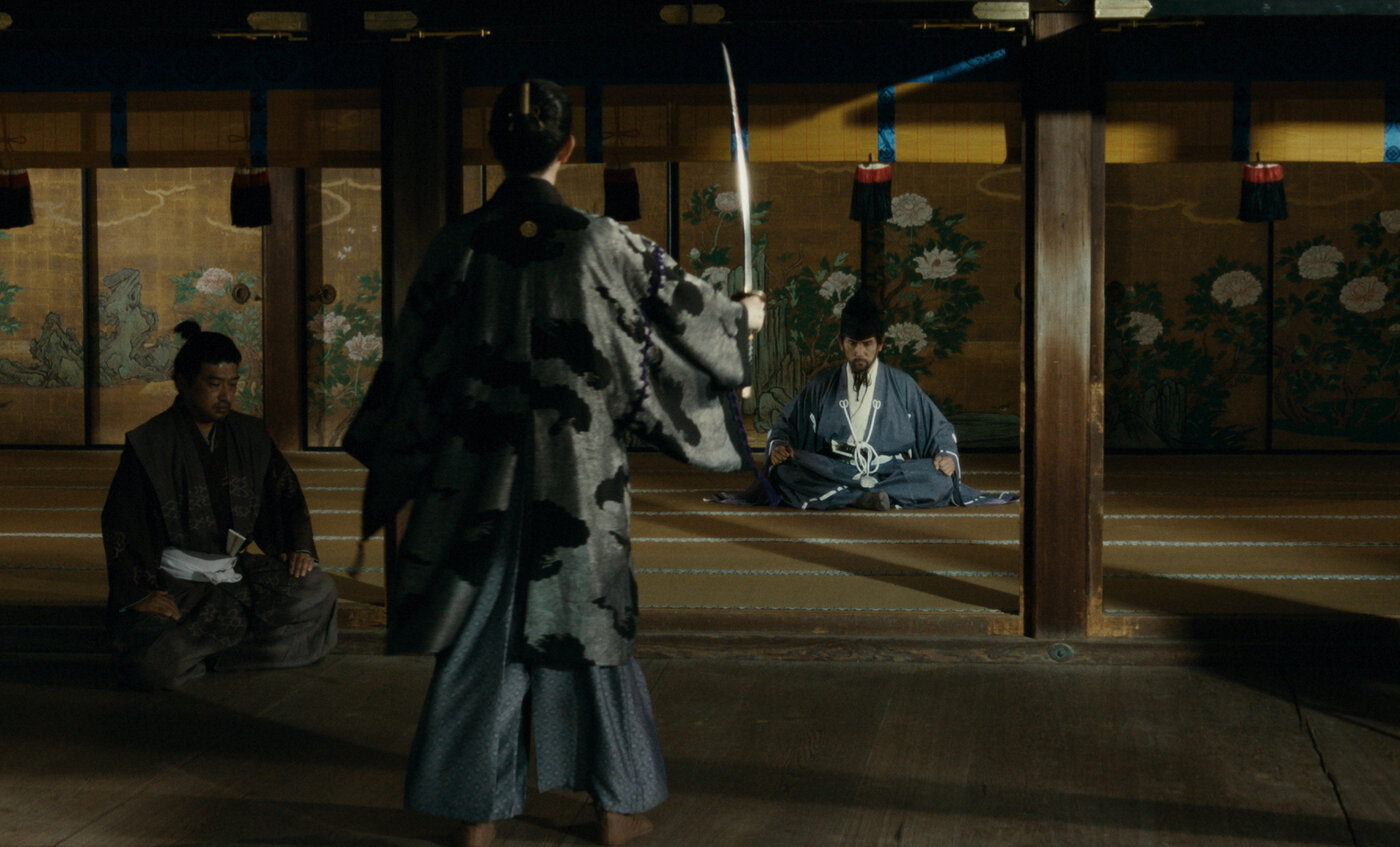
The Samurai and the Prisoner (Kiyoshi Kurosawa, 2026).
Ever since he first broke into the Western cinephile consciousness with Cure (1997) and Pulse (2001), Kurosawa Kiyoshi has frequently been canonized as a horror auteur. This lens has been applied and reapplied to each of his films by distributors and critics alike, with the generic conventions of horror centralized as the key means of packaging and understanding a prolific body of work. Too often, though, this understandable but shallow view of Kurosawa’s filmography has missed the forest for the Charisma tree; the release of the director’s elegant new jidaigeki, The Samurai and the Prisoner (which boasts the scarifying title of “Black Prison Castle” in Japan), affords an opportunity to revisit and reframe a remarkable career.
Kurosawa has regularly stated that he has never considered himself to be a “horror director,” and that he is entirely forward looking (whether the futures he perceives are bright is another matter). In a 2019 interview with Tokyo University of the Arts (where he is also a professor), Kurosawa stated, “I don’t much want to set my themes, my styles, etc., in stone, you know? I want to do lots of things. I’m often asked, ‘What do you want to do next?’ but the response that is easiest to understand is ‘I want to do something that isn’t what I’ve done up to now.’” Although Kurosawa has been lauded as an absolute master of the horror genre, granting him a privileged position even before the current boom of so-called “elevated horror”—and frequent name-checks from reviewers squinting for reference points in the low light of Obsession (2025)—it has come at a cost—specifically, how his work has been analyzed as a whole. The “horror master” designation has perhaps helped some of his other films attain a viewership, but this has sometimes come at a cost too—of how those films themselves are seen. This is especially infelicitous given that Kurosawa has long shown a desire to toy with generic conventions rather than find himself beholden to them. When observing his body of work as a whole, it is far more coherent to consider Kurosawa’s pictures in terms of themes and movements rather than genres.
Kurosawa’s filmography can be coarsely divided into two epochs: his early works and his main body of films. These groupings are not absolute but they map the shifting perception of the director from craftsman to auteur. Between 1973 and 1997, Kurosawa’s feature-length cinema was primarily a scattershot mélange of gun-for-hire genre assignments, from “pink” comedies to yakuza crime pictures to traditional J-Horror; while certainly present on the festival circuit, he was not typically appraised as a master. The quality of these films varies, but the unevenness belies an accruing formal confidence (or, in the case of Sweet Home [1989], a lack of control over the finished work—Kurosawa sued Itami Productions in a failed attempt to prevent the film’s re-shot and re-edited form from being distributed). Kurosawa used this part of his career as a formal staging ground for experimentation; many early visual or structural ideas would notably be incorporated in his later, more famous projects. Rather famously, the Godardian experimentation in the “pink” film The Excitement of the Do-Re-Mi-Fa Girl (1985) was such that it was canned by the producers. The film is a mix of late-1960s Godard symbolism and aesthetic choices and a narrative on psychological research which mirrors David Cronenberg’s Stereo (Tile 3B of a CAEE Educational Mosaic) (1969), pleasing in its pop art frolicsomeness and use of Itami Juzo, but hardly the titillating and exploitative work the production company wanted.
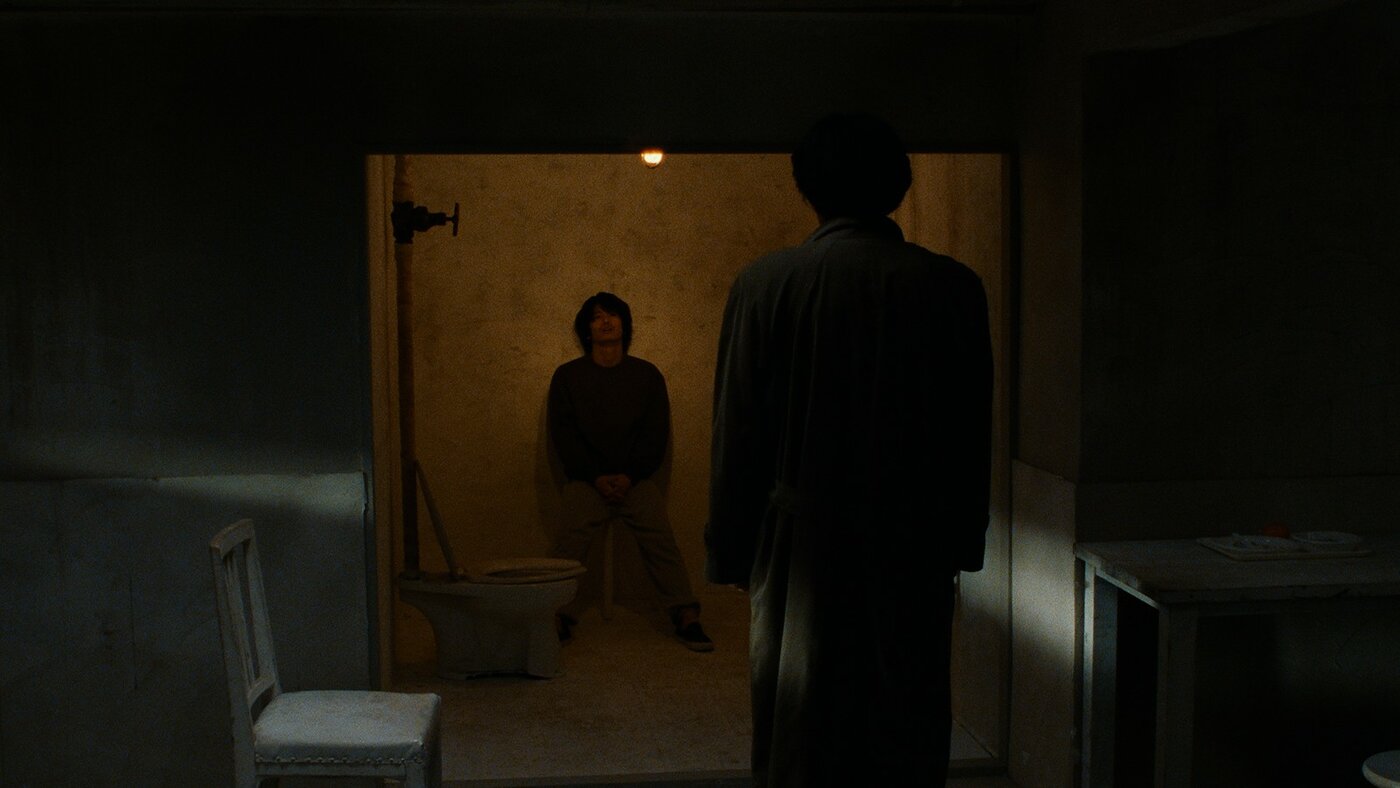
Cure (Kiyoshi Kurosawa, 1997).
The Excitement of the Do-Re-Mi-Fa Girl went unreleased until Kurosawa bought the completed work and released it himself. Kurosawa’s second period starts with Cure at the end of 1997, and it features increased consistency and authorial control—the latter quality embedded in this film’s deployment of a sinister hypnotist stage managing his prey, Caligari-style. Both periods share thematic concerns and stylistic flourishes: Excitement and Cure both revolve around psychology students, the most infamous sequence in Pulse—the “wobble walking” ghost—was already workshopped in Door III (1996), and the main thesis for much of Kurosawa’s career—as well as the comedic tones of both License to Live (1998) and Doppelgänger (2003) was articulated in the slapstick made-for-TV short Whirlpool of Joy (1992). This period contains all of Kurosawa’s most famous works—including Cannes-ratified titles like Bright Future (2003) and Tokyo Sonata (2008) as well as the occasional foray into V-Cinema and television, and some particularly experimental (and not always acclaimed) deep cuts.
In order to best understand Kurosawa as an artist (and especially this second period of his career), it is important to consider the context of postwar Japan. The “economic miracle” of Japan (1955–1973) covers the first portion of Kurosawa’s life. Born in 1955, Kurosawa experienced its early years growing up in Kobe, a major center of heavy industry and manufacturing, land reclamation projects, and port development. Economic growth slowed in 1973 due to the oil-price shock, then rebounded, coinciding with a consumer electronics boom (although it did not re-enter a period of “miracle” growth). By the mid-1980s, Japan’s economy had slipped into recession. In the late 1980s, an asset price bubble began to grow, and was characterized by the rapid escalation of stock market and real-estate prices. Through what was later discovered to be wholesale corruption on virtually every level of Japanese society, the bubble proved unsustainable. When the bubble finally burst in 1991, it kicked off what macroeconomists refer to as the “Lost Decade.” The “Lost Decade” became “Lost Decades,” and Japan’s economy has yet to recover. As one might expect, the financial loss was felt most heavily by the average citizen.
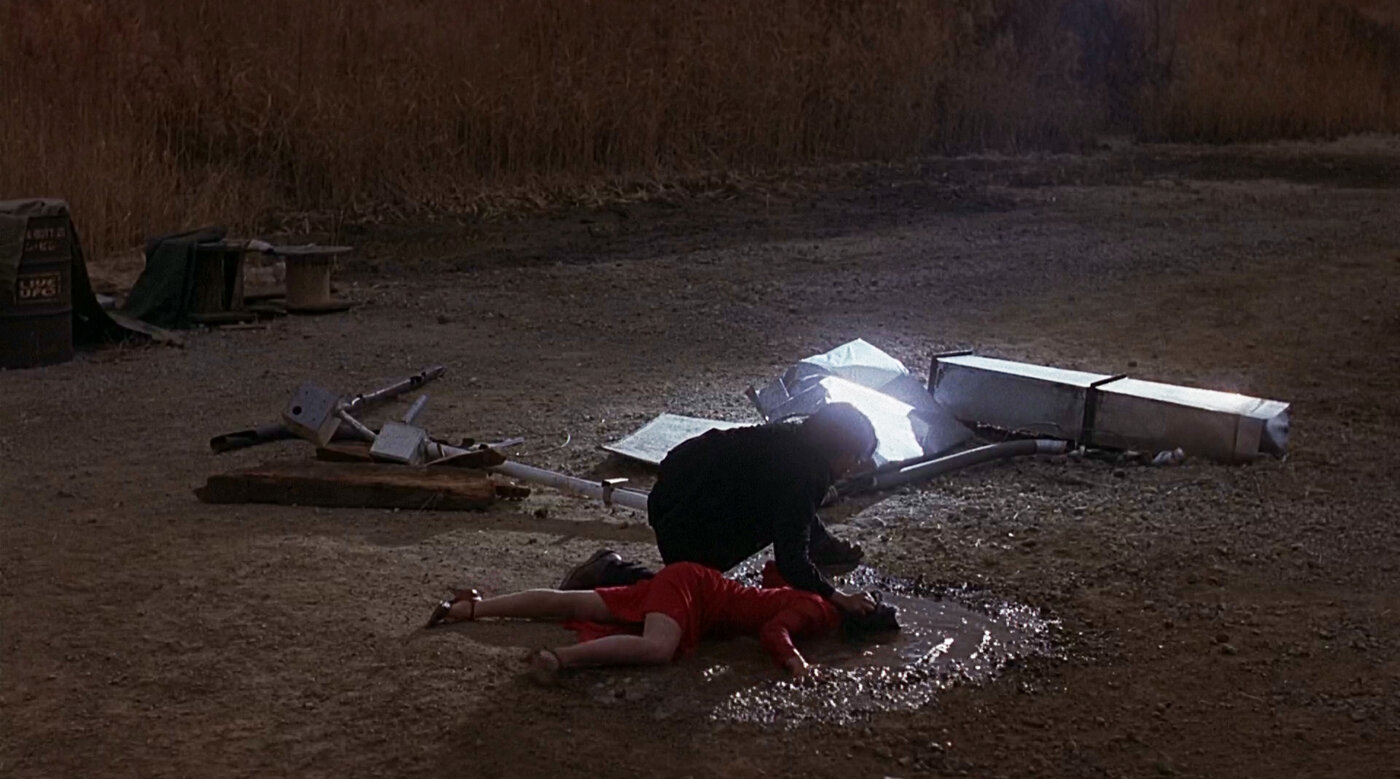
Retribution (Kiyoshi Kurosawa, 2006).
Various realist movements have had a strong influence on the films made during the second era of Kurosawa’s career. Although he eschews some of the typical conventions of neo-realism (such as non-professional actors and the use of documentary or documentary-like footage), his work (in line with his cinematic forebears such as Jean Renoir) self-consciously and authentically reflects the economic and social conditions of the day, even when the films skew toward the fantastical: Cloud (2024) is preoccupied with market forces; even a flatly supernatural tale like Retribution (2006) exists in a recognizably workaday world. Kurosawa has witnessed the economic ennui and social decline born from the various recessions of his lifetime,and the devastating impact of the asset price bubble burst and its social and economic fallout have greatly impacted his cinema. And yet, while Kurosawa’s films occasionally depict nihilism—the standard reading of the apocalyptic visions in Pulse, Charisma, (1999) and Cloud—they are anything but nihilistic. Instead, they seek an honest reckoning with their late capitalist moment—an unsentimental but humane moral clarity—that those living through the depicted conditions may miss because it cuts so close. This deep pathos, which accesses the emotional without wallowing in mawkishness, is part of what makes Kurosawa a phenomenal artist beyond his precise technique. However, this is also the aspect of his work which has been most often overlooked by Western commentators.
Kurosawa’s work prior to The Samurai and the Prisoner has been grounded in explorations of a devastated national identity, ennui, and alienation. Cure, Eyes of the Spider, (1998) and Cloud are all informed, in whole or in part, by the effects of the “Lost Decades” recession in Japan: the angst is felt ambiently. He observes the total collapse of patriarchal order in the anti-Ozu film Tokyo Sonata centered on a family unit being pulled in several directions—kicked off by the father’s unemployment—and lugubrious devastation and misogyny in the supernatural thriller Loft (2005), which unfolds among a set of present-tense ruins. Films like Pulse, with its Y2K anxieties, isolation, and social failure, and Doppelgänger, which observes how technology can destroy human relationships as much as build them, portray technology-as-mediation of reality and each other. This is even better exemplified with the criminally underrated Real (2013), a film whose reputation has suffered from the expectation of Kurosawa as a horror director—something the film does not stick to (ditto Journey to the Shore [2015], a ghost story without scares). Each of these films paint a picture of a society trying to patch a communal hole with electronics, though it would be wrong to reduce the films’ worldview to simple technophobia. The existentialist meditation on the shifting conditions in pre- and post-bubble Japan in the zany, borderline-screwball License to Live tackles the need to create one’s own meaning and value. Even questions of national identity and sense of direction such as those in Charisma, Barren Illusion (1999), and the WWII-era espionage drama Wife of a Spy (2020) are contending with the experience of modern Japan.
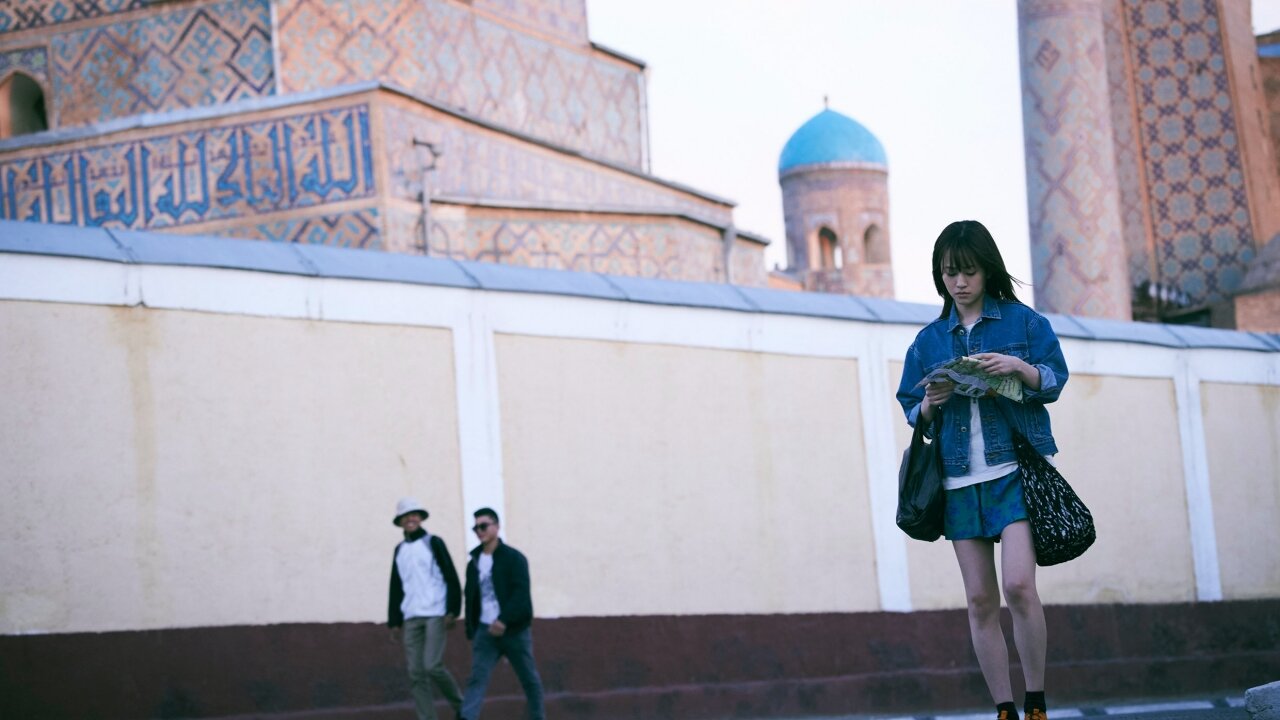
To the Ends of the Earth (Kiyoshi Kurosawa, 2019).
Kurosawa’s work has also taken him outside of the country, providing a kind of offbeat counterpoint to his usual setting. Both Daguerrotype (2016) and the 2024 Serpent’s Path remake are French productions, To the Ends of the Earth (2019) is an Uzbekistani-Japanese co-production, and Seventh Code (2013), while still a solely Japanese production, deals explicitly with experiences of Japanese immigrants in post-Soviet countries. Even setting these examples aside, it is not as though the perspicuity of Kurosawa’s other pictures is exclusive to a Japanese audience. Issues pertaining to technology, economic alienation, and national identity are also broadly digestible, even if the specifics pertain to Japan. Whether working within Japan, or in an international context, Kurosawa’s films are timely and prescient, and he has maintained a consistent thematic north star.
This all changes with The Samurai and the Prisoner, perhaps Kurosawa’s most thematically ambitious film. Although it contains many formal and stylistic connections to Kurosawa’s past filmography, it charts new thematic and generic territory. Even Wife of a Spy, Kurosawa’s only other period piece, concerns itself foremost with questions of modernity—its eye is on the historical horizon. In fact, for a film which is so steeped in the legacy of Japanese cinema (not to mention culture, religion, and history), The Samurai and the Prisoner (which looks back without being reactionary) is his most cosmopolitan work. It is impossible to discuss every aspect of this epically scaled drama without disclosing critical plot details best left to a cinematic screening, but a short synopsis can still be suggestive of its scope and concerns. The film follows the actions of Lord Araki Murashige, a real historical figure, and his retinue of retainers during the second siege of Arioka Castle (1578–79). Murashige had previously rebelled against Lord Oda Nobunaga’s forces, and was awaiting the arrival of reinforcements from the Mori clan (a necessary condition of his eventual victory). The film begins with the arrival (and subsequent imprisonment) of Kuroda Kanbei (a man best remembered as one of the most brilliant strategists of the period), who was sent by Nobunaga in order to persuade Murashige to surrender. Instead of shooting the messenger, Murashige imprisons him, kicking off a battle of wills that spans a cycle of seasons.
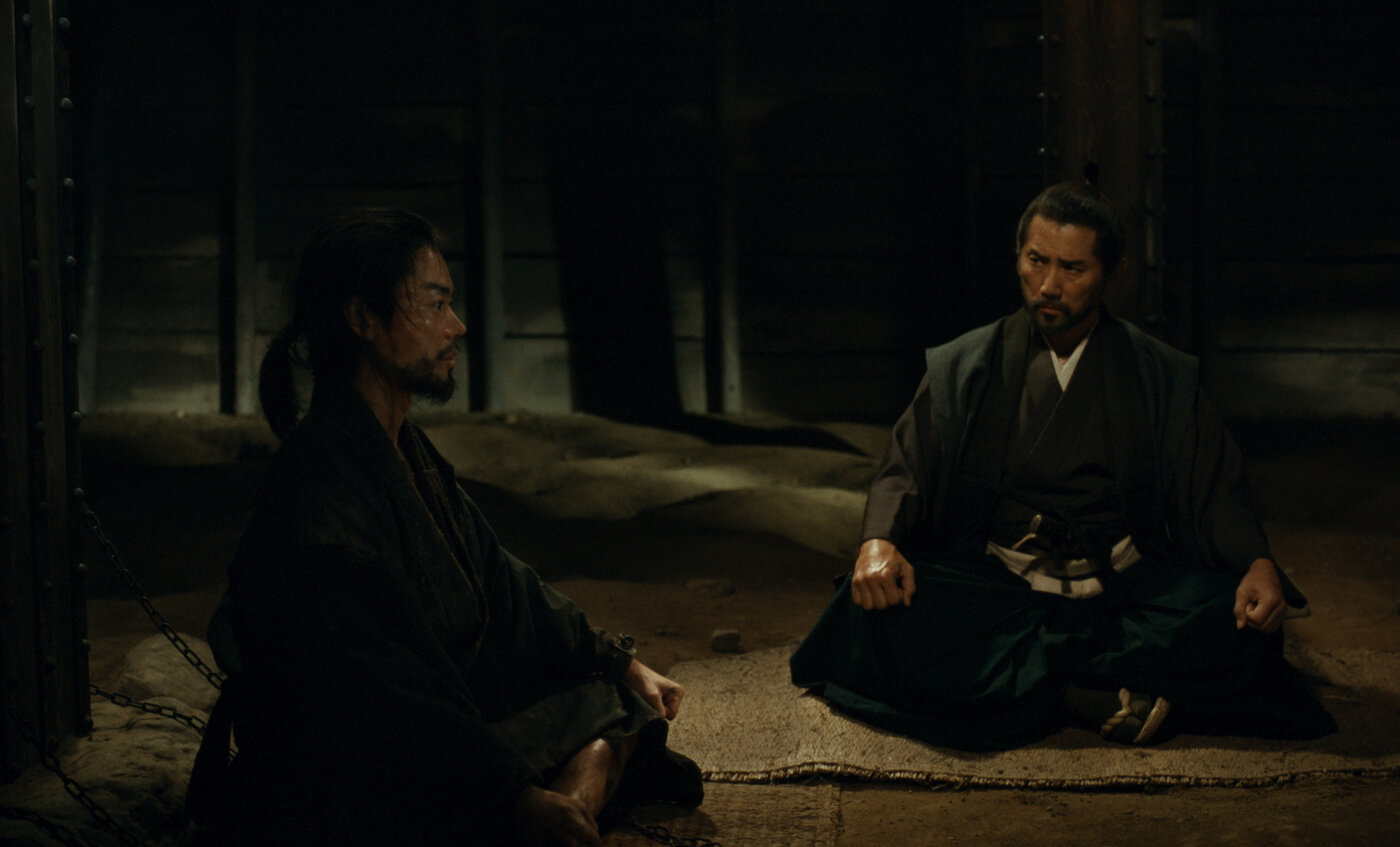
The Samurai and the Prisoner (Kiyoshi Kurosawa, 2026).
The Samurai and the Prisoner is set apart from these other works by virtue of its assertive and imperative qualities. Whereas Kurosawa’s past filmography has sought to elucidate, The Samurai and the Prisoner seeks to prescribe—a shift perhaps commensurate with advancing age and stature (an impulse that finds more satirical expression in the coda of Cloud, which ends with a character offering advice). Murashige is seemingly a self-portrait of sorts for Kurosawa, and after decades of diagnosing the ills of a modern world defined by alienation—and putting his observations in literally or figuratively scarifying terms—the filmmaker now wishes to push, calmly but urgently, for a fundamental, structural change. There is a lot of talk of strategy and victory in The Samurai and the Prisoner, both between clans and between individuals, and yet the stakes exist outside such frameworks. It is not a matter of winning or losing, but reorienting ourselves toward hope and abandoning the death cult of the status quo, first as an individual, and then by provoking collective action. Although this echoes the character arcs in Charisma and Bright Future, the context is quite different. In Charisma, Yakusho’s Yabuike rewrites the rules of the world, and in Bright Future, Odagiri’s Nimura decides to make his own moves to push society in some small way (to say nothing of Hagiwara’s hypnotist in Cure). However, all of these are examples of characters responding to the social order of the day and taking action within that framework. The Samurai and the Prisoner takes a different tack, with Murashige opting to step outside of that framework entirely: The samurai refuses to be a prisoner of tradition (the English title is a germane reference to the protean and mercurial positions held by the cardinal characters). It is not sufficient to merely attempt to enact change, as Murashige does initially—his martial aims are comparable to those prior examples—instead, he takes an additional step, outside of the frame of the world itself. If you have seen the truth of the world through the lens of Kurosawa’s camera, you have no choice but to seek something different, as Murashige does; as Kurosawa himself does. Furthermore, in embracing the Sengoku period, The Samurai and the Prisoner is the first work where Kurosawa contends with the gargantuan legacy of Akira Kurosawa, particularly the films Throne of Blood (1957), an inescapable reference given the primacy of palace intrigue, and Kagemusha (1980), another self-portrait which manifests in the margins of Kiyoshi’s formal language, like annotations.
Thus, it is the film of a dreamer, of an artist who has spent his life gently engaging with his audience in the hopes of helping them (and himself) recognize a broken world; now, he delineates a path toward a better one. In this respect (and several others), the film also has much in common with Kagemusha (if not 1990’s Dreams). Like Kurosawa (Kiyoshi), Kurosawa (Akira) was 70 years old when he made that exceptional jidaigeki. Like The Samurai and the Prisoner, Kagemusha’s narrative centers on a stand-in for the director, who aspires to a heroic, world-changing standard. But whereas Kurosawa (Akira) looks back at the samurai as a heroic ideal that he has failed to live up to (in a sense, failing to live up to the ideals of his samurai family ancestors), Kurosawa (Kiyoshi) idealizes a figure who is a sort of anti-samurai, someone who rejects custom and wishes to change the world. Much like in Kagemusha and Throne of Blood, most of The Samurai and the Prisoner’s violence occurs offscreen, and that which doesn’t is not fetishized or glorified; instead it is portrayed as an ugly reality. Throne of Blood’s Lady Asaji (Yamada Isuzu) is invoked in the way that characters contend with their guilty, violent consciences. The difference between the two directors is that Kurosawa (Kiyoshi) does not idolize the samurai, either as an ideal or a historical reality.
This also sets Kurosawa’s adaptation apart from the best-selling novel upon which The Samurai and the Prisoner is based. Although still a relatively faithful adaptation (Kurosawa has spoken of the source text with admiration), it differs considerably from the original novel in its thematic purview. While the novel establishes Murashige as something of an anomaly, his strategies and overarching beliefs are firmly within the realm of the samurai. Kurosawa mythologizes Murashige differently, aiming to establish him as a subversive, revolutionary figure, one who seditiously disregards tradition to redefine the rules of engagement and the conditions of victory (“To win without killing,” as one character states). In a sense, Kurosawa (Kiyoshi) seeks to succeed where Kurosawa (Akira) failed, although not in a confrontational way. There is no point debating which auteur “gets it right” or which approach is superior. Kurosawa (Kiyoshi)’s aims are more subtle, and unlike those of Kurosawa (Akira), it is harder to gauge his artistic successes and failures.
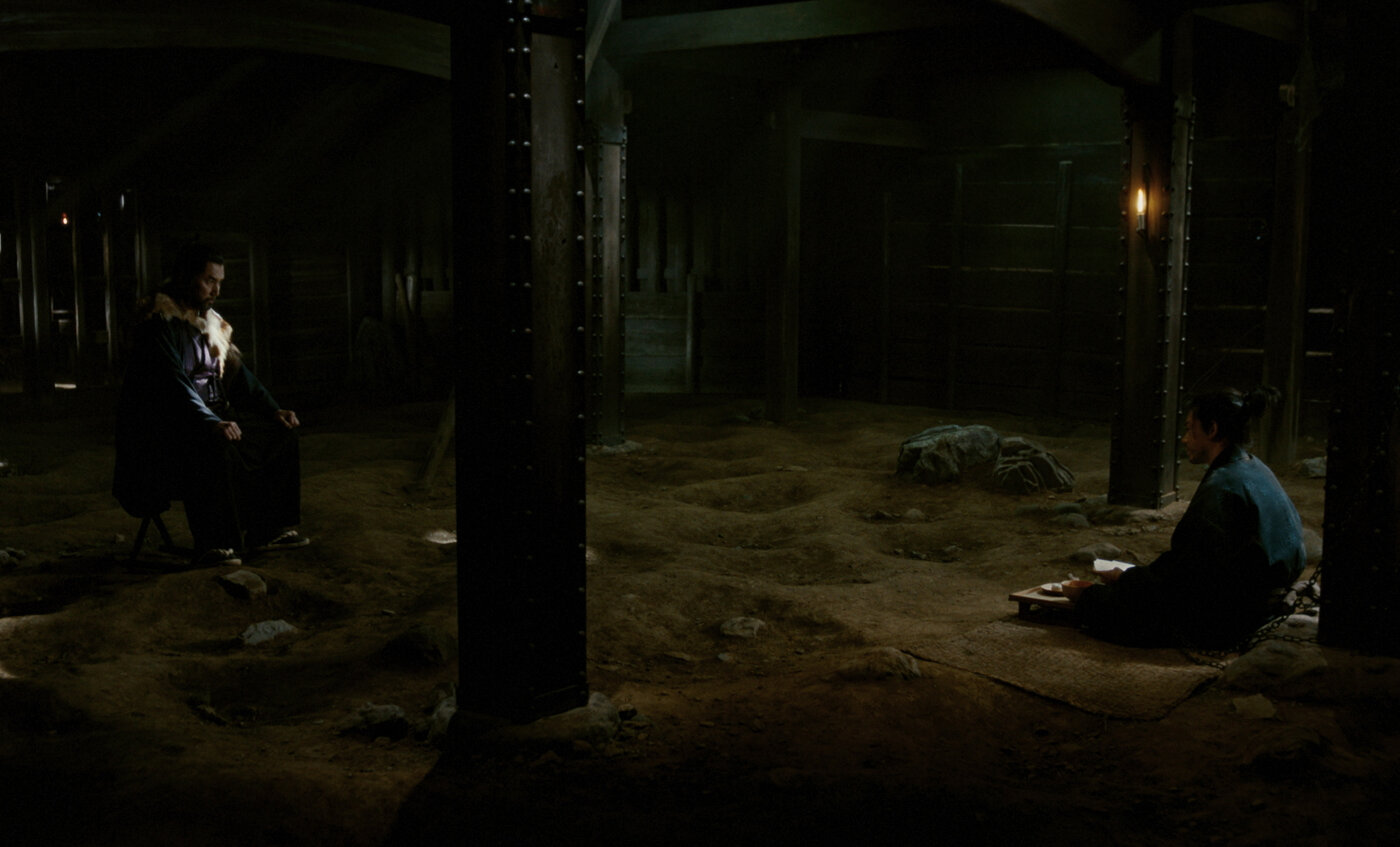
The Samurai and the Prisoner (Kiyoshi Kurosawa, 2026).
Irrespective of one’s evaluation of the legacy of Japanese cinema, The Samurai and the Prisoner stakes its most persuasive claim on the level of form. The spider that features in the plot (and the poster design) is an emblem of a narrative crafted as a web of intrigue and deceit. Scenes are staged and sutured together at a brisk pace; the frequent long takes have a rhythmic perfection which recalls Mizoguchi Kenji’s finest works. Motile subjects (and their motivations) are obscured and revealed by fusuma sliding doors, pillars, and walls, perpetually shifting in and out of sight; close-ups are at a premium. The titular prison is an expansive mass of shifting sands (and allegiances) which resemble the dunes in the ever-changing Zone of Stalker, in stark contrast to the novel’s historically accurate cell (also resembling any of Kurosawa’s cavernous warehouses without end). Masahiro Motoki is brilliant as Murashige, as is Arakawa Yoshitaka as Chiyoho, but it is Suda Masaaki, the sullen cyber-honey-badger of Cloud, who delivers a frankly astounding turn as Kuroda Kanbei, the titular prisoner. The centerpiece of the film takes the form of three consecutive scenes, one for each of the principal trio: moments of unveiling given the force of revelation. All three stand among the most formally perfect sequences in Kurosawa’s oeuvre, and as the conjoined emotional and philosophical core of the film, they are impeccable.
The final sequence of The Samurai and the Prisoner is markedly different from previous Kurosawa films. While the endings of Cloud, Chime (2024), and the Serpent’s Path remake all mark an openness—a kind of forward progression—they are hardly optimistic about what could come next. To paraphrase the Buddhist koan at the center of The Samurai and the Prisoner, they are advances to Hell. Conversely (and critically), The Samurai and the Prisoner’s ambiguous—but in its way, satisfying—ending paves the way for future optimism. The immediate outcomes are not necessarily what any of the characters involved wanted, but that is ultimately beside the point, for the filmmaker as well as the characters; we end on grace notes of solidarity, duty, and devotion (for the characters as well). Rather, the ending explores the conditions of the possibility of better outcomes for all of humanity, and how we can orient ourselves to them. The final scene’s focus on the wind in the trees recalls “impermanence” and the unseen reality in the Buddhist tradition; Murashige’s Zen philosophy and Kurosawa’s artistry converge on the breeze (another commonality with the other Kurosawa’s films).
“I think this act of taking something that we cannot typically see and then, through its movement, being able to confirm its existence—to show us and reassure us that it’s actually there—is very much akin to cinematic expression itself,” Kurosawa told The Film Stage. “So wind, to me, is not so much something that is spiritual, but I think of cinema as something that is there for us to be able to capture the wind … [it is] almost like cinematic expression itself. The finale is divorced from that which came before, seemingly standing outside of both time and space, with an ascension for the characters who have abandoned their agendas in favour of responding appropriately to the way the wind blows.”