“Ad Infinitum” is the fall 2025 edition of the Notebook Insert, our seasonal supplement on moving-image culture.
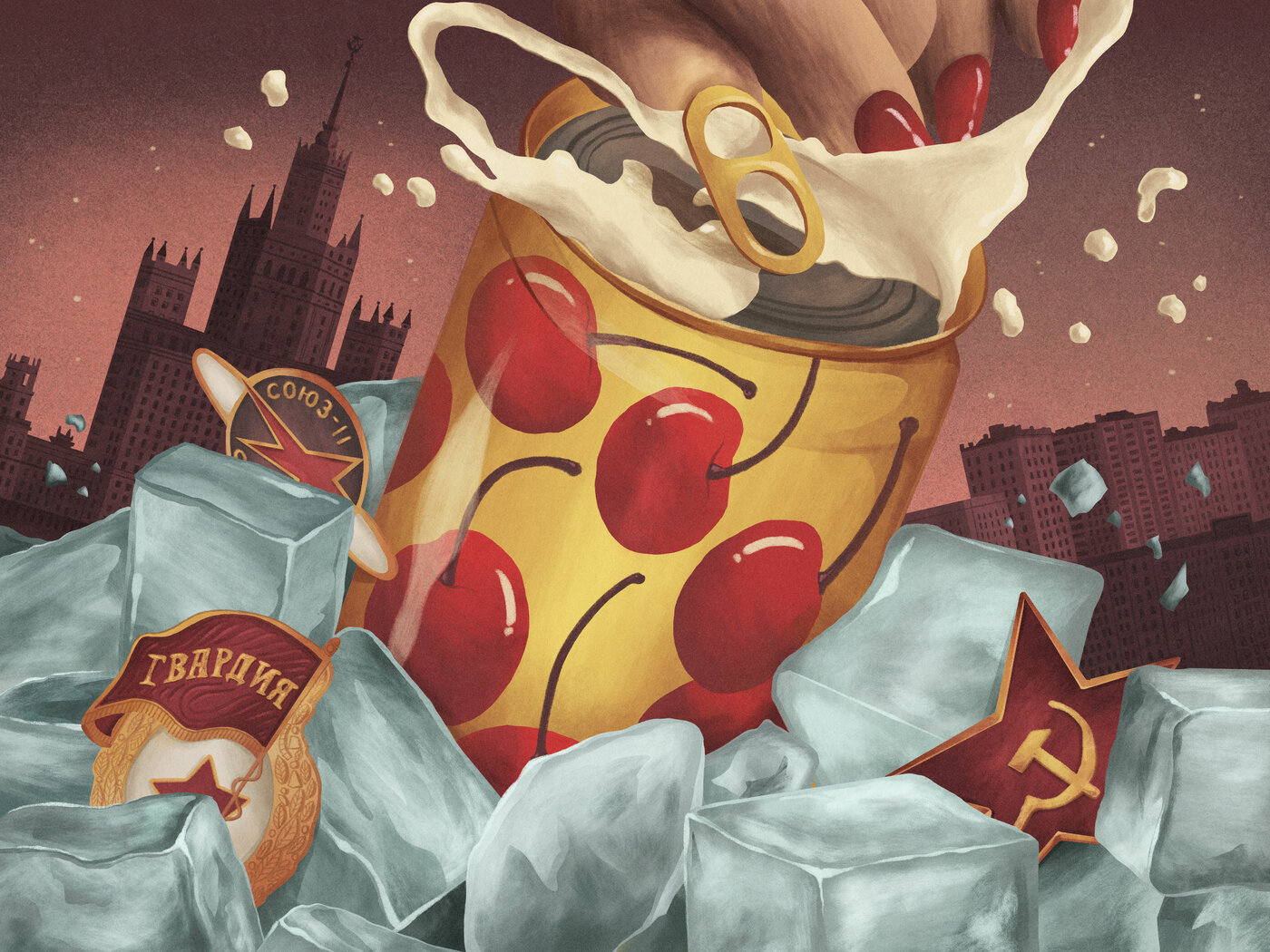
Illustration by Michelle Urra.

In 1989, RAND Corporation staffer and former US State Department employee Francis Fukuyama famously argued that the fall of the Berlin Wall marked “the end of history.” His thesis was that the deterioration of the Soviet Bloc’s brand of state socialism was also the terminus of mankind’s ideological development: At last, our species had reached its final, restful form in free-market capitalism and liberal democracy. Over the ensuing decades, Fukuyama has expanded this idea into book-length form, reconfigured it, and most recently, walked it back. He was, he now admits, very wrong. But his storybook sentiment aligned with the air of triumph in the United States in the late 1980s. What could be more of a victory lap for American values than presiding over the end of history?
A first principle of capitalist legitimacy had always been that the free market served to reflect the self-identity of liberal subjects, framed foremost as consumers. Advertising and global statecraft were conceived as conjoined projects in the United States. The Advertising Council was born as a private-public partnership during the Second World War, initially to promote armed-forces recruitment, the sale of war bonds, and the conservation of war materials. But in the immediate postwar years, when the Soviet Union shifted from a tenuous and expedient ally to certifiable red menace, the Ad Council reframed its raison d’être in terms of “a colossal struggle to determine whether freedom or statism will dominate.” Its late-1940s “The Miracle of America” campaign bombarded radio and television airwaves to declaim the virtues of American-style capitalism (as opposed to the more pro-labor Western European models), explicitly connecting economic and political liberties.
In 1985, Mihkail Gorbachev stepped in as the General Secretary of the Communist Party and introduced perestroika, hoping to end the twenty-year “Era of Stagnation” by marketizing certain aspects of the state-controlled economy. That year, a flood of American television commercials began to claim victory over the Soviets, citing as proof of American superiority the nation’s preponderance of consumer products: beer, fast food, and soda chief amongst them.
The commercials presented below are drawn from research for my forthcoming film Argonauts at the End of History, which follows a group of Soviet sailors who receive sponsorship from PepsiCo in 1989 to join a dangerous—and extremely costly—around-the-world sailing race. Tragedy would ensue. And by the time the nearly yearlong sail was over, there was no longer a Soviet Union to which to return. Being “at sea” is an apt metaphor for times of unpredictable and destabilizing societal changes, in which personal and societal grief fuse into a profound sense of disorientation.
Pepsi is a handy avatar for the advertising wing of the American Cold War corps. The company’s path through the twentieth century is littered with a veritable who’s who of red-baiting, CIA-led coups, and market capture as diplomacy. An abbreviated list: Just a few years prior to launching the Red Scare movement that came to bear his name, Wisconsin Senator Joseph McCarthy was paid $20,000 by Pepsi to lobby on the Hill for the end to wartime sugar rationing, earning him the nickname “the Pepsi-Cola Kid.” Pepsi Chairman Donald Kendall was a close friend of Richard Nixon’s, one of the most stalwart Cold Warriors. “I am a Republican,” Kendall bragged, “and I happen, in addition, to be an absolutely dedicated Nixon man.” In 1959, during the famous “Kitchen Debates” between then Vice President Nixon and First Secretary Nikita Khrushchev in Moscow, Kendall engineered a way to get a glass of Pepsi into Kruschev’s hand. Years later, in 1974, Pepsi would become the first American product to be officially produced, marketed, and sold in the Soviet Union. In 2004, Kendall was awarded the Order of Friendship by Vladimir Putin.
Through his senior partnership at the law firm Nixon, Mudge, Rose, Baldwin, and Todd, which handled the Pepsi account, Nixon became a goodwill ambassador of sorts for the brand, traveling the world on its behalf. (After a meeting with Ambassador Henry Cabot Lodge, his former running mate, in Saigon, he responded to reporters curious about their political plans: “We had a very interesting discussion and actually made a deal. He is going to put a Pepsi-Cola cooler in the embassy in Saigon.”) In 1970, a Chilean Pepsi bottler and media baron, Agustín Edwards, informed Kendall that the newly elected socialist leader Salvador Allende planned to nationalize all of Chilean industry—Pepsi included. Kendall called then President Nixon, and Nixon summoned Henry Kissinger and CIA director Richard Helms, whose notes from the meeting include the phrase “Not concerned [about] risks involved.” Allende died by suicide during the 1973 US-backed military coup that installed Augusto Pinochet.
Pepsi provides a particularly clear—and especially bloody—materialist example of the investment, both literal and figurative, many US corporations had in the downfall of the Soviet Union. The fall of the Communist governments ruling the Eastern Bloc opened up vast new markets to Western capital. That’s one reason for a victory lap. But there’s a broader, more fantastical ideological work at play here. These American commercials were produced between 1985, the year of the first Reagan-Gorbachev summit in Geneva, and 1998, when the Russian financial system completely collapsed. A 1985 piece in the San Francisco Chronicle, “The Cold War Goes Prime Time” cites these ads as indicative of a “renewed sense of American nationalism,” quoting the political scientist Jerry F. Hough: “There’s an awful lot of self-satisfied smugness around…. We want to believe that nothing’s changing, that all the old comfortable stereotypes are still going to apply. And it’s wishful thinking.’”
The ads were made on budgets both enormous and humble, advertising everything from motel chains to regional electronic appliance stores. Taken together, they feel like a desperate play at self-assurance, trafficking in stereotypes about the USSR that were already many decades stale. It’s not difficult to see in their gloating a deliberate delusion about the deprivations of the losers, but also the spoils of the winners. During the same period in the United States, the consecutive Reagan, Bush, and Clinton administrations oversaw the steady deterioration of social programs. These ads gleefully mocked their Soviet straw men while the Americans they addressed found themselves in an increasingly precarious economic position.
Meister Brau Beer, “USSR Ambassador,” 1985
In the dark chambers of the Soviet embassy in Washington, one apparatchik asks another where the rest of the graft they’ve budgeted for beer is being spent, having learned from their “operatives” that Meister Brau “only tastes expensive.”
Wendy’s, “Soviet Fashion Show,” 1985
“Having a choice is better than not,” an American-accented narrator clumsily intones as Soviet brass and babushkas dutifully applaud a versatile earth-toned one-piece, which is unconvincingly analogized to hamburger toppings.
“Soviet Fashion Show” was filmed at South Shore Country Club in Chicago, with Howard Fishlove (whose sole IMDB credit is a bit part in The Blob (1958)) playing the model. The gold Cyrillic script inscribed on the red banner that festoons the catwalk apparently reads: “Keeping your teeth clean at all times is important.”
The ad debuted the week of Reagan and Gorbachev’s Geneva Summit, and a torrent of opinion pieces and letters-to-the-editors accused it of potentially jeopardizing the peace process. “Fashion Show is a sharp parody on life in the Soviet Union and the rather limited freedom of choice available to its citizens…mightn’t something even as innocuous as a television commercial…upset whatever delicate understanding the two leaders reach?” read a typical example of hand-wringing from Newsday columnist Daniel Kahn.
RC Cola, “Our Friends,” 1986
Beginning in 1974, Pepsi was the first soda company to officially do business in the USSR—indeed, the first American consumer product to be manufactured and sold there. Coke followed in 1979. The $10 million “Our Friends” campaign presents Pepsi and Coke as conspirators with the Soviet state, while RC Cola remains the only soda company to remain as contraband, not “selling out” to the USSR.
A spokesperson from Dancer Fitzgerald Sample, the agency who produced “Our Friends,” explained the campaign’s origins: “When Coke joined Pepsi as the only authorized colas in the Soviet Union, that stirred our imagination. Somewhere out there we know there are millions of consumers who refuse to follow the party line and who would truly go out of their way for an RC.”
Highland Appliance, 1987
A regional Michigan-based electronics and home appliances outfit, Highland Appliance went public in 1985 and filed for bankruptcy in 1991. Notice the convention of depicting young Soviets enraptured by American products: In the Meister Brau spot, it’s a hot rod “with tail fins”; here, a trio of English-speaking Soviet naval officers surface from their submarine in search of “jumbo savings” on radios and VCRs (and hit on a woman shopping for washing machines along the way).
Best Western, 1989
Yakov Smirnoff—born Yakov Naumovich Pokhis in Odessa—worked as an entertainer on cruise ships on the Black Sea before immigrating to the US in 1977. Smirnoff, who pulled his stage name from the vodka he served customers as a NYC bartender, had his breakthrough with Robin Williams in Moscow on the Hudson (1984), after which he became America’s go-to comedian for anti-Soviet send-ups; he was a regular on Late Night with David Letterman (1982–93), and even supplied jokes for Reagan’s speechwriters to pepper in during meetings with Gorbachev.
These 1989 commercials for Canadian Best Western hotels make use of his catchphrase, “What a country!”, though here, this sentiment is aimed at the US’s northern neighbor. Shortly thereafter, Smirnoff’s comedy career collapsed; with the end of the USSR, the American demand for an anti-Soviet jester disappeared.
In a 2007 interview, he recalled, “Film roles dried up. Contracts for gigs in Las Vegas, Reno, Tahoe, and Atlantic City weren’t renewed. “I wasn’t savvy enough to understand why,” Smirnoff says. “So I started looking for a place where they did not know the Soviet Union had collapsed.” He moved to the Missouri Ozarks and opened a 2,000-seat theater in Branson.
Pepsi, “A Generation Ahead,” 1989
At the base of a snow-covered St. Basil’s Cathedral, young Soviets convene to skateboard, dance, and inhale bottles of Pepsi before a punk show, seeming to substantiate the soft-drink corporation’s explicit claim that Western consumerism exists on a different timeline, à la its 1960s slogan, “For Those Who Think Young.”
Doritos, 1990
In a Monty Python–esque intrusion into the frame, Doritos—a PepsiCo property—eats away at a Communist Party meeting. A YouTube commenter advances the idea that the actor standing at the podium is Kyiv-born Boris Sichkin, who played Leonid Brezhnev in both Oliver Stone’s Nixon (1995) and the made-for-TV movie The Final Days (1989), based on Woodward and Bernstein’s reporting on the Nixon White House following the Watergate revelations.
Korbel Champagne, 1991
Korbel Champagne, which has the unsurprising distinction of being “the Bay Area’s only champagne” (it was grandfathered in—along with Miller High Life, “The Champagne of Beers”—before the passage of the 2005 law that dictates only wines produced in the Champagne region of France can be marketed as such), first aired this commercial during a broadcast of the Charles Bronson–starring made-for-TV movie Yes Virginia, There Is a Santa Claus (1991).
Earlier that year, Korbel president Gary Heck announced that the company was creating its first foreign export program: “I believe that if you are going to survive you have to be an international company.” Thirty years earlier, his father, Adolf Heck, hosted a Soviet delegation including First Deputy Premier at his winery. According to USSR, a Soviet-side sister magazine to the US State Department’s publication Amerika, “Billions of dollars of potential trade was the theme…the Soviet party motored through the beautiful Sonoma Valley country, were shown through the Korbel Winery near Guerneville by owner-brothers Ben, Paul and Adolf Heck, and lunched with members of the Bohemian Grove Club under giant redwoods.”
This commercial, produced by FCB/Leber Katz Partners, first aired on December 8, 1991, the same day the Belavezha Accords were signed to establish the Commonwealth of Independent States in place of the Soviet Union. The penultimate shot in the advertisement show Boris Yeltsin waving the tricolor flag of the Russian Federation, with the tagline “We have so much to celebrate.” The Soviet Union would officially dissolve seventeen days later, on Christmas Day.
Barq’s Root Beer, “The Soviet Union Going Out of Business Sale,” 1992
According to the advertising executive Rick Hill, watching live news coverage of the collapse of the Soviet government on Christmas Day, 1991, brought to mind “those Oriental rug and appliance sales you see all the time: ‘We've lost our lease and are selling out to the bare walls!’” He pitched “The Soviet Union Going Out of Business Sale” for a Barq’s Root Beer campaign a week later.
After subbing in Brighton Beach tchotchkes for a photoshoot with the Associated Press, Hill and his attorney flew to the Soviet Union and spent around $70,000 on two tons of the real thing—pins, flags, and “Communist party favors”—a purchase he claimed was facilitated by the Soviet mafia. This looted Soviet memorabilia would be sent out to US customers as part of a wildly successful Barq’s promotion.
Neon-hued intertitle overlays reminiscent of MTV, a carnival barker voiceover (“Quit Stalin!”), and false subtitles for a Gorbachev speech in the Supreme Soviet (“We’ve Lost Our Lease! Everything Must Go!”) lend a desired air of the forced liquidation of a strip mall to the proceedings.
Pizza Hut, 1998
In 1990, PepsiCo, Pizza Hut’s parent company, brokered an arrangement with the Soviet Union that Pepsi execs crowed was “the deal of the century.” In addition to opening Pizza Huts across the USSR, they planned to open 24 new Soviet bottling plants, financing it all by selling vodka (largely Stolichnaya) and leasing Soviet tankers built in Ukraine, a trading agreement they expected to net $3 billion in profits.
More humiliation ritual than anything else, this commercial purportedly paid former Soviet leader Mikhail Gorbachev what would be seven figures in today’s dollars (though one of his conditions was that he would not eat any pizza on camera).
At this point, Gorbachev was deeply unpopular in Russia, having initiated the rapid liberalization of the Soviet Union that would quickly unravel the nation altogether. He was something of a pariah, portrayed as either a naïf or a traitor, and his personal financial situation was dire.
The commercial ends with crowds outside Pizza Hut cheering “Hail to Gorbachev!” The commercial’s editor said, “If you listen to that sound, ‘Hail to Gorbachev,’ it sounds like the entire nation of Russia is chanting ‘Hail to Gorbachev.… It has this impression, you might say illusion, that the entire nation feels this is a wonderful thing that happened.”
Eight months after this commercial aired during the 1998 Rose Bowl, the Russian financial system collapsed.
A different sort of end of history.

Continue reading “Ad Infinitum.”