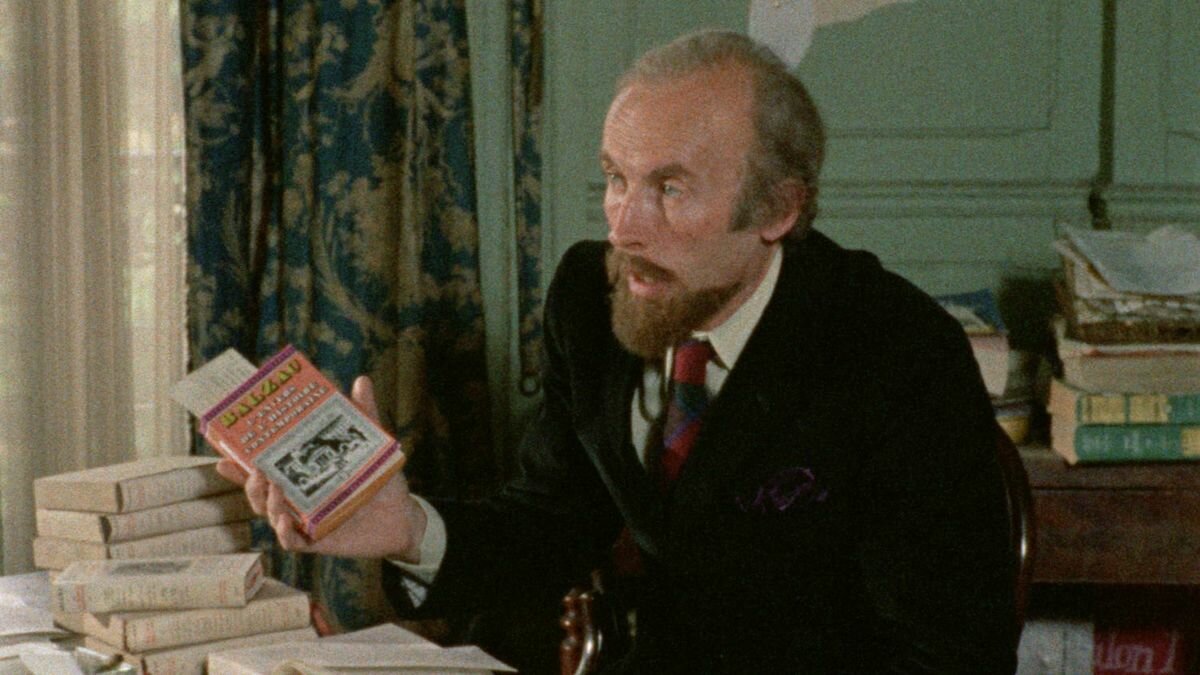
Éric Rohmer in Out 1: Noli Me Tangere (Jacques Rivette, 1971).
In 1946, the prestigious French publishing house Editions Gallimard published a novel called Élisabeth by a man named Gilbert Cordier. No one had heard of this Cordier before, or knew anything about him, for the simple reason that he didn’t exist.
“Cordier” was a pseudonym adopted by a young teacher of Latin and Ancient Greek from Tulle named Maurice Scherer. When Élisabeth was released to blanket disinterest, Scherer began to branch out from literature into film criticism, and, later, filmmaking. With each new endeavor, the pseudonyms piled up. If, in 1949, you were to pick up a copy of Bulletin (the in-house publication of the Latin Quarter Film Club, a society of cinephiles which served as an early gathering place for the young turks of the French New Wave), you would find in its pages an effusive review of a film by a young avant-garde filmmaker named “Anthony Barrier,” penned by one “Jean d’ER.” Both characters—and even the film under review—were inventions of Scherer’s. Today, the man who went by Cordier, Barrier, and d’ER is known to most people by another, different pseudonym: Éric Rohmer.
This fondness for trickery and deception may surprise those who know Rohmer as the maker of elegant, if unassuming, films in which France’s erudite young bourgeoisie walk around, fall in and out of love, and discuss their lives in verbose detail. Rohmer’s predilection for bamboozlement and false appearances are, however, on full display in Élisabeth, the latter-day filmmaker’s sole novel, which is now being published in an English translation for the first time. A work of surprisingly experimental temperament for a filmmaker best known as the nouvelle vague’s staunch traditionalist, Élisabeth exposes just how ill-fitting that reputation has always been.
Watch Rohmer’s first feature The Sign of the Leo (1962) with innocent eyes, and you would be forgiven for failing to detect his later filmmaking signature. A morality tale reminiscent of Guy de Maupassant’s miserablist naturalism, it is a far cry from the volubility and unadorned refinement of his mature films. Sculpted in long wordless passages and populated by vaudevillian tramp-philosophers swiped straight from Samuel Beckett, it gives few hints of the director to come.
Élisabeth, on the other hand, establishes some quintessentially Rohmerian motifs. Taking place during a stifling summer in the Normandy village of Percy, the novel observes the amorous entanglements of a holidaying bourgeois milieu as they languor in the heat, miscommunicate, and fail to make decisions about their lives. Those basic narrative elements would later become the foundation of Rohmer’s iterative cinema: “I do not discover; I combine some primary elements in small amounts, as a chemist does,” he once said.1 Things happen in Élisabeth, but without dramatic fanfare. There are no moments of revelation or grand progressions. The novel’s most significant “events,” as in his cinema, are everyday thoughts, attitudes, and gestures.
Despite nothing much happening, Élisabeth demands laborious attention. Its characters are purposefully vaporous, and long reams of talk go by in which unidentified speakers blur together. In one scene, Michel poses as his cousin, Bernard; no reference is made to this doubling in the narration, which only becomes apparent after the fact (and only if you are paying close attention). Locations and characters are divided across a fragmented structure, wrongfooting the reader with unadvertised leaps in perspective and tenses. Even its title is a misdirection; the titular Élisabeth is not, as one would assume, the protagonist of the novel, but a secondary character who sits on the periphery of the narrative.
Élisabeth’s willful modernist difficulty sits in striking counterpoint to Rohmer’s limpid style as a filmmaker. His mise-en-scène is fastidious but unshowy, with an eye for modest beauty. Rohmer favored medium shots using 50mm lenses, which best approximate the natural gaze of the eye, but also lend a subtle tableaux-like prettiness to his compositions. Cutaways to impressionistic details—trees in the wind, hair in the sun, drifting clouds—and an occasionally schematic use of color are his biggest stylistic indulgences. He worked simply, shooting fast, with a small crew, often using the humbler 16mm format for the nimble efficiency of its cameras. This style looks even more reserved (and politically quietist) when placed alongside the ostentatious formal antics and sloganeering agitation of his nouvelle vague contemporaries.
Long before he was a filmmaker, Rohmer had already established his pointedly unradical outlook during his tenure as a critic (and, later, editor) at Cahiers du cinéma, the legendary publication which served as the intellectual crucible of France’s postwar cinematic revolution. Under his editorship, the paper studiously avoided questions of politics; he was later ousted by fellow filmmaker Jacques Rivette, who encouraged writers to engage with contemporary intellectual and political developments. (Rivette himself was replaced by a militant collective of Maoists, who transformed Cahiers into a kind of cinephilic Pravda for the next half-decade). Still, Rohmer’s own writing regularly strayed outside of the narrowly aesthetic constraints he claimed to observe, airing unapologetic chauvinisms about the inferiority of “Oriental” cultures—and the inherently white, “Occidental” character of the seventh art—in his own criticism (he later refused to have these texts republished, calling them “monstrously naive” and “reactionary”).
Rohmer’s only novel, on the other hand, shares a shock family resemblance to postwar France’s most aggressively anti-classical cultural object: the nouveau roman, or “new novel.” Orbiting the center of gravity provided by Alain Robbe-Grillet (another novelist-turned-cinéaste) and his bullish manifestos, the writers of the nouveau roman were united less by a coherent style than an antagonism toward the conventions of literary realism: character, plot, and the moribund nineteenth-century humanism which provided its intellectual foundations. In his theoretical writings, Robbe-Grillet called for the novelist to pay attention to the sheer there-ness of the universe in place of the ready-made explanations of the old novel, an aesthetic he dubbed chosisme (“thingism”). One of his totemic slogans decreed that “the world is neither meaningful nor absurd. It quite simply is”; another, that “the novel that contains character belongs well and truly to the past.” Nathalie Sarraute, Claude Simon, and Marguerite Duras (yet another convert to the cinema from the novel) were the nouveau roman’s fledgling practitioners; Élisabeth shared shelf-space, and even a publisher, with early examples by Duras and Simon.
The nouveau roman could reach almost unintelligible levels of abstraction, but its basic hostility toward literary realism has echoes in the flat, affectlessness of Élisabeth’s prose, with its disregard for psychological explanation and its lengthy passages given over to obsessive physical delineations. (Spatial inventories were a major feature of Alain Robbe-Grillet’s writing, which rendered the world as a mere agglomeration of surfaces). Rohmer noted the connection between himself and the nouveaux romanciers on more than one occasion, suggesting a tantalizingly odd counterfactual history in which Rohmer—a self-identified classicist, Royalist, and practicing Catholic—“threw his lot in” (as he claimed to have been tempted to do) with the Left Bank’s Marxist avant-garde. Rohmer even contended (somewhat preposterously) that contemporaries like Duras and Simon had retained “too many traces of the old rhetoric” next to his “far more systematic” rigor, likening Élisabeth to the paradigm-shifting modernisms of cubism in painting and twelve-tone technique in musical composition. In time, the complement would be paid back: When Rohmer’s 1986 film The Green Ray won the Golden Lion at Venice, Robbe-Grillet, the jury chairman, dismissively announced to reporters that he “didn’t like it much.”
As a critic at Cahiers, Rohmer displayed a talent for flummoxing intellectual feints and evasive ideological maneuvers. The young writer mounted defenses of tradition and classical culture via dizzying rhetorical inversions which upended the terms of the debate: “In cinema, classicism is not a step backwards but a step forward”; “If it’s true that history is dialectic, at some moment conservative values will be more modern than progressive values”; “The classical age of cinema is not behind us, but ahead”; “For me what is really new is an idea that never dates.” He had a habit of quoting Arthur Rimbaud’s famous injunction to be “absolutely modern,” but even this was a characteristically droll sleight of hand. In an interview to mark the publication of his collected criticism, he clarified his meaning: “to be modern sometimes means being backward looking.”
Paradoxes of another kind contribute to Élisabeth’s thick air of inscrutability. Rohmer may lavish attention on surfaces in its pages, but he is also keen to point out that appearances deceive. More than any specific traits, his characters are defined by an internal inconsistency that seems to emanate from their very essence. Irene, Michel’s fiancée, is described as beautiful, but in the same way as a “painting or statue that seems to represent something slightly other than what it is—the beauty of something that isn’t quite itself.” Michel (the novel’s de facto protagonist) muses that other people give “the impression, the same impression, of resembling themselves precisely,” whereas he “seemed to shift from hour to hour, from day to day.” At other times, characters speak in equivocations and tautologies which only deepen the air of unknowability hanging over them. “You look like someone who looks the way you look,” says one character to another, recalling the arch, ouroboros-like quips which pepper the work of British novelist Ivy Compton-Burnett, who was claimed by Nathalie Sarrautte as a forerunner to the French new novel.
Not only do characters slip in and out of focus, but they also struggle to understand themselves. The closest thing in Élisabeth to a climax is a long diatribe offered by Michel, during which he vents his secret feelings of disgust toward Irene (their engagement hangs in the balance throughout the book). After several pages of relentless bile, Michel lamely concludes: “I don’t even think the things I think.” It is these self-contradictions, more than his class background or his talkativeness, which mark Michel out as a Rohmerian protagonist. “I know what the problem with Michel is,” Élisabeth reflects, toward the novel’s conclusion: “he’s bold, but indecisive.” Élisabeth is talking about her son, but she could just as easily be discussing any of the filmmaker’s subsequent protagonists, whatever the medium.
The gulf hinted at by Élisabeth, between a person’s appearance and their substance, would eventually provide the thematic backbone of Rohmer’s cinema, manifested in the many characters populating his work whose behavior never quite matches the self-image they project. Listen to the lengthy and erudite introspection of his talkative protagonists, and it seems like they have it all figured out. Time and time again, however, they fail to meet their own ideals. Capitulating to temptation, chance, or the anguish of indecision, they find themselves locked in dialogues de sourds with their own resolve. As a devout Catholic and one-time existentialist, Rohmer was all too familiar with this risible little tragedy of free will: His characters are condemned to freedom in a double-fold sense, Sartrean and Biblical.
Of the many vacillating characters in Rohmer’s oeuvre, Delphine, the protagonist of The Green Ray, has become the de facto archetype. Played with brittle hauteur by Marie Riviere (the greatest of the director’s young female collaborators dubbed the Rohmeriennes), Delphine spends the film’s runtime frittering away her summer. She bemoans the absence of romance in her life, but refuses to engage with any of the men who come her way. She wants to go on a vacation, but she keeps turning down perfectly good offers; the few she does go on, she abandons almost immediately, returning to Paris to complain again each time. She outsources her hopes to the omens of cartomancy, reading signs into playing cards she occasionally finds on the floor. “I’m not stubborn,” she justifies to one friend, “life is stubborn.”
Just as Delphine resigns herself to return to Paris for the final time, both of the things she has been searching for—a genuine chance at romance and a promising vacation—seem to land in her lap when a pleasant-seeming young man asks her to accompany him to Saint-Jean-du-Luz for a few days. Rather than recognizing a good thing when she sees one, Delphine lets fate decide. She hopes to see the titular green ray, a flash of emerald light occasionally seen at sunset rumored by legend to reveal a person’s true feelings. Rohmer shows us the ray streaking across the horizon, but, ever-sardonic, he never reveals Delphine’s decision. Opting for the ready-made answers of superstition, she has already excused herself from making one.
Rohmer’s deadpan humor resurfaces in the name “Delphine” too, a winking joke from the trained classicist. Riviere’s character takes her name from Delphi, the sacred city considered by the Ancient Greeks to be the center of the world. The city gave its name to the legendary oracle who dwelled in the Temple of Apollo on the sacred slopes of Mount Paranassus, where those seeking their fates could receive her divinatory proclamations. To reach her, travelers would first have to pass through an entrance with two words carved above it: Know Thyself. Of all the adages, aphorisms, and mottos in Rohmer’s filmography—whether offered by his prolix conversationalists or epigrammatically affixed to his Comedies and Proverbs—that edict of self-knowledge looms above the rest, unspoken and unheeded.
Rohmer may have known himself, but he went to great lengths to ensure that others didn’t. He hid throughout his life behind pseudonyms, shrouding his personal life (including such details as his birthday and birthplace) in misinformation, and even concealing his filmmaking career from his own mother, who died believing her son was an unknown teacher. As a public figure, too, he was a welter of contradictions: a conservative who rubbed shoulders with leftists and revolutionaries, a self-proclaimed “anti-existentialist” who acknowledged a lifelong debt to Sartre, a maker of the most talkative films who admired the silents above all others, a classicist who venerated modernity. “There are not enough lies in cinema,” Rohmer once wrote, but he certainly contributed his fair share. Élisabeth only adds to the enigma.
1. Letter to a critic [concerning my Contes moraux] (Originally published in La Nouvelle Revue française, 1971).” Collected in The Taste of Beauty (Cambridge University Press, 1990). Quote on page 81.