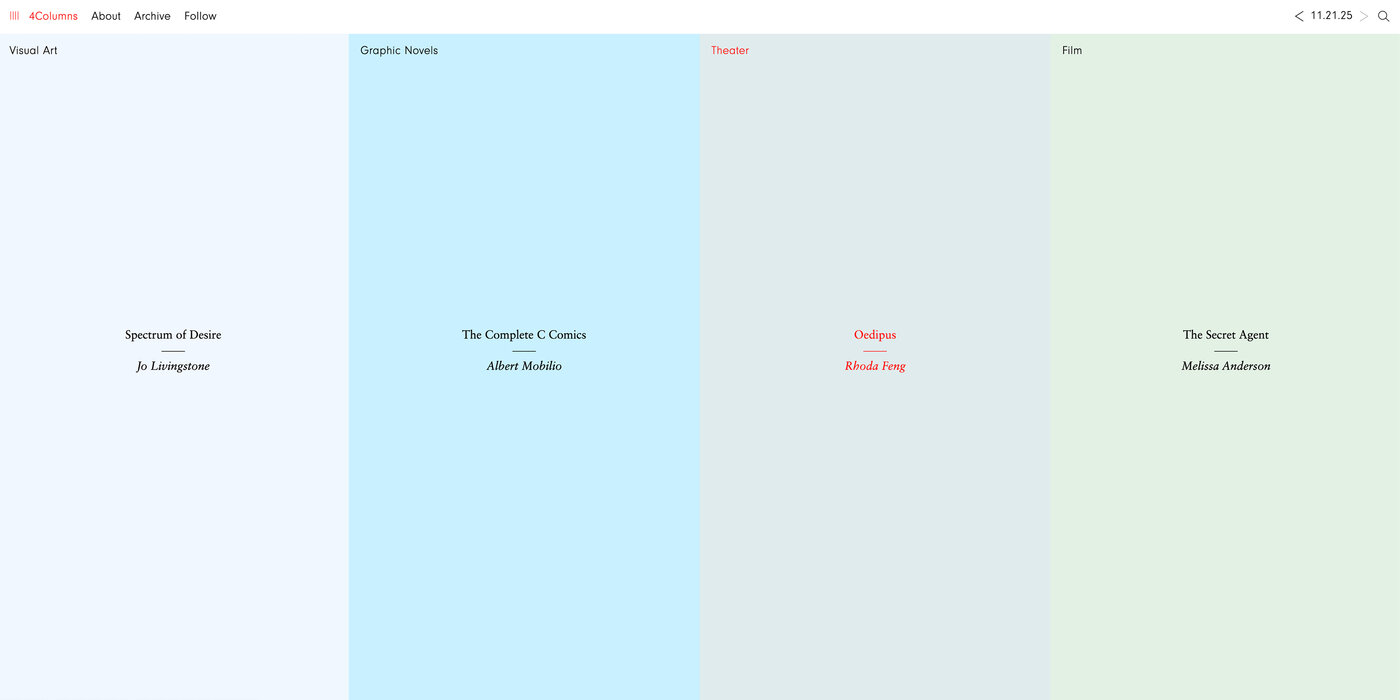
4Columns website, November 21, 2025 issue.
The best job I’ve ever had—and the one that I’ve held the longest—ended on June 26. That’s when 4Columns, the weekly online arts-criticism site founded by editor-in-chief Margaret Sundell, which debuted September 23, 2016, published its final issue after a decade-long run. I was there for nine of those years, serving as the magazine’s film editor and lead film critic.
I started at 4Columns in September 2017, roughly a month after meeting Margaret to discuss the position. She was looking to expand the site’s film coverage; I was looking to leave the Village Voice, where I had been the senior film critic since late 2015 and the unit chair of the union. Throughout the summer of 2017, my union comrades and I had been locked in bitter, increasingly hopeless contract negotiations. In August, we realized just how hopeless: The billionaire who had bought the eternally being-revived Voice in 2015 announced he was shutting down the print version of the paper, decimating the masthead. The next year, right before Labor Day, he abandoned the website.
By the time I began at 4Columns, just days after leaving the Voice, I felt depleted and disconsolate. Quickly, though, I was revitalized. The remit of my new job was blissfully straightforward: assign one film (or film series, or, very rarely, a TV show) to be covered each week. This essay would constitute one of the four pieces—other fields included visual arts, books, music, and theater—that came out every Friday morning. Two reviews per month I assigned to myself; the others I commissioned from the most talented writers I knew, some of whom pitched me, others whom I approached. Already a delightful task, the matchmaking element of the job was made even more gratifying by the fact that I could offer freelancers $1,000 for 1,000 words, the standard length of a 4Columns essay.
Choosing what to cover provided its own pleasures: The film highlighted on any given week could be new or old, playing for a week or more or only one night. (New York City’s repertory and first-run offerings largely determined which movies were assigned.) This freedom of choice—Margaret essentially left it up to me to decide what was worthy of our readers’ attention—stood in stark contrast to other weeklies I had worked for, where the mandate was to cover every new film opening theatrically in New York. During my 2005–2009 stint as the film editor at Time Out New York, for example, I was often benumbed by the sheer weekly glut of titles to be covered, sometimes twenty or more. Three decades prior—when the number of new releases was smaller—Renata Adler, recalling her 1968–69 tenure as the chief film critic for the New York Times, piquantly described this superabundance when she noted “the movies themselves coming over the hills in swarms, so many of them nearly indistinguishable, some of them really fine.”
In that same remembrance, Adler discusses another pitfall of her post: “the number of utterly deadly films that came out, tolerable to sit through, nearly impossible to discuss.” During my pre-4Columnscareer as a critic, whether as a staffer or a second-, third-, or fourth-string freelancer, I had spent unfathomable swaths of time staring in agony at a blinking cursor, trying to compose words—anywhere from 150 to 800—on a movie (a Sundance fatuity, a Wikipedia-deep documentary, a Euro mediocrity) for which ten would have been more than sufficient. To have the luxury of selecting the one film that most excited or intrigued me or the other film contributors obviated that misery.
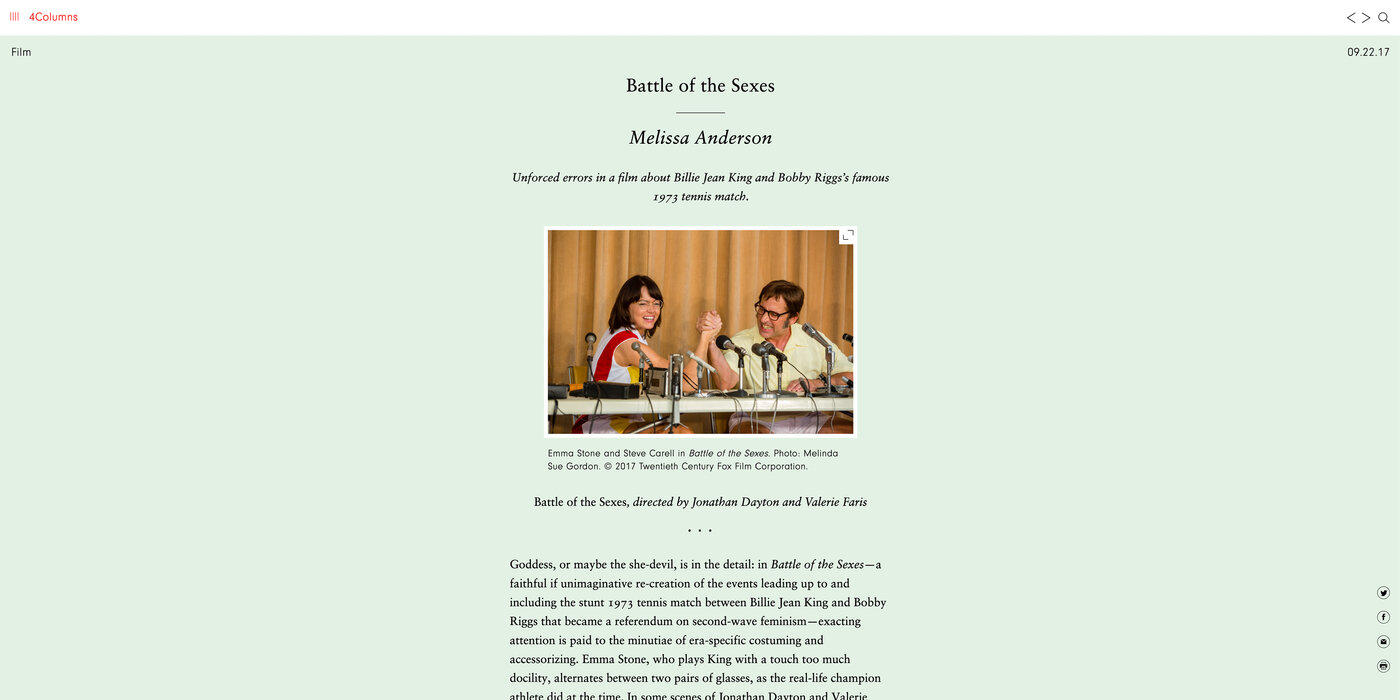
4Columns website, review of Battle of the Sexes (2017).
Another horror we were spared from: advertising of any kind. Conceived as a finite project, 4Columns was fully funded by a private foundation; no retinal-assaulting pop-up ads distracted readers from the publication’s elegant, uncluttered design by Everything Studio. The magazine was not just ad-free; it was simply free, period—no subscriptions were required. While all of us at 4Columns—we were a staff of five—hoped, of course, that the site would be read by billions, we were never driven by metrics. The only hyperlink to be clicked in any article was the writer’s name as it appeared in their bio at the end of each piece, which led to a list of their previous 4Columns contributions.
Above all, 4Columns was a writer’s publication, a showcase for a vast array of styles, idiosyncrasies, points of view. It was the kind of forum in which turns of phrase such as “raging daughter of Bilitis that I am” and “lesberation”—deployed in my first 4Columns review, of Battle of the Sexes, a staid Emma Stone–starring docudrama about the stunt 1973 tennis match between Billie Jean King and Bobby Riggs—were left completely untouched, with no edits demanding explanation. (My 4Columns word cloud would likely feature “lesbian supremacy,” “misandry,” and “heterosexual depravity” in the largest font.) But while my sapphic doggerel may not have been interfered with, Ania Szremski, the magazine’s senior editor, nonetheless emended each of my reviews with pinpoint precision, making corrections (some the result of her assiduous fact-checking) and suggestions that always improved whatever I had written.This fine-tuning continued with the astute copyediting of associate editor Bonnie Chau, who also came up with the crisp, witty one-line summaries that ran with all of the pieces in an issue. (The fifth member of our staff, chief information officer Julie Evanoff, cheerfully kept all systems running smoothly, including the prompt payment of writers.)
I wanted to give the same care, attention, and respect that was shown to me as a writer to those I edited. Although there were certain despised words—“journey,” “titular,” and “indeed” chief among them—that always warranted a fussy note from me whenever I encountered them, I took inspiration from the Hippocratic oath whenever I opened a writer’s Word document: First, do no harm. To edit is an extremely intimate act, one that requires curiosity, delicacy, and humility. I wanted writers to feel they could implicitly trust me as we endeavored to make a piece, over the course of however many drafts were required, even sharper.
Adler describes her fourteen-month stretch at the Times as “a particular kind of adventure.” The product of Margaret Sundell’s ingenious conception, 4Columns was not only an adventure but also a bold imagining of what an online publication devoted to arts criticism could do (present impassioned essays for a general readership, pay its writers adequately) and could look like (sleek, inviting, free of commerce). It was an adventure that gave me nine of the most rewarding years of my life.