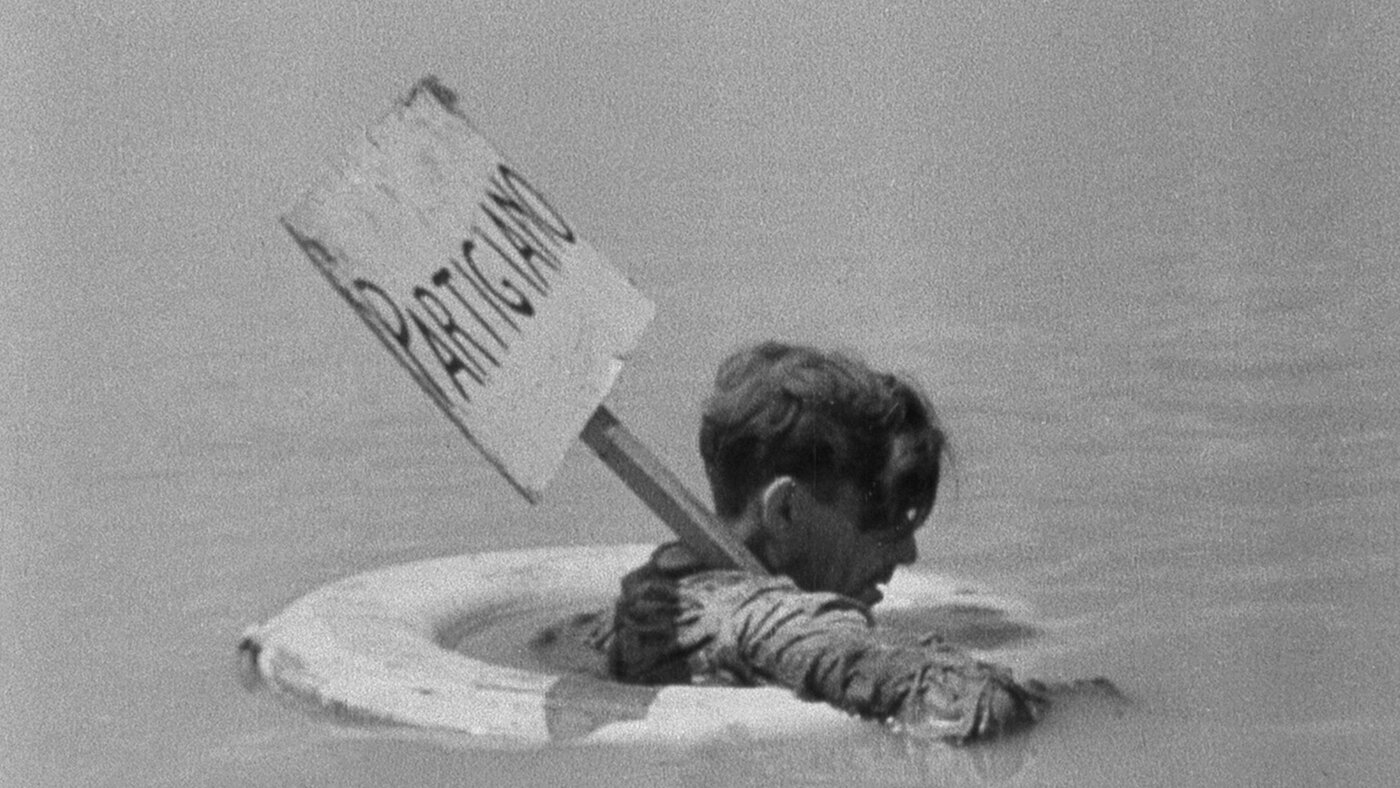
Paisan (Roberto Rossellini, 1946).
The camera lingers: on a partisan’s body drifting down the Po river in Roberto Rossellini’s Paisan (Paisà, 1946), and then—eight years later—on an old man gathering kelp alone along the shore of the island of Sado in Kenji Mizoguchi’s Sansho the Bailiff (Sanshō Dayū, 1954). In each, a single figure is held in a long, distant take, and becomes our way into a nation’s suffering. Both exemplify the “aesthetic of reality” André Bazin prized. “It is no longer the editing that selects what we see […] it is the mind of the spectator,” the critic wrote, in reference to Orson Welles’s Citizen Kane (1941), but also thinking of Paisan itself—a freedom won through long takes, deep focus, and a refusal to subordinate cinematic space to montage.1 In both cases, the objects before the lens bear the weight of recent catastrophe. Postwar Italy’s bombed-out façades and the famine-wrought coastlines of feudal Japan function as repositories of national memory, exposing wounds that reconstruction might otherwise conceal. Historical circumstances, however, pushed the two directors toward very different times: one in the immediacy of the present and the other in the distant past.
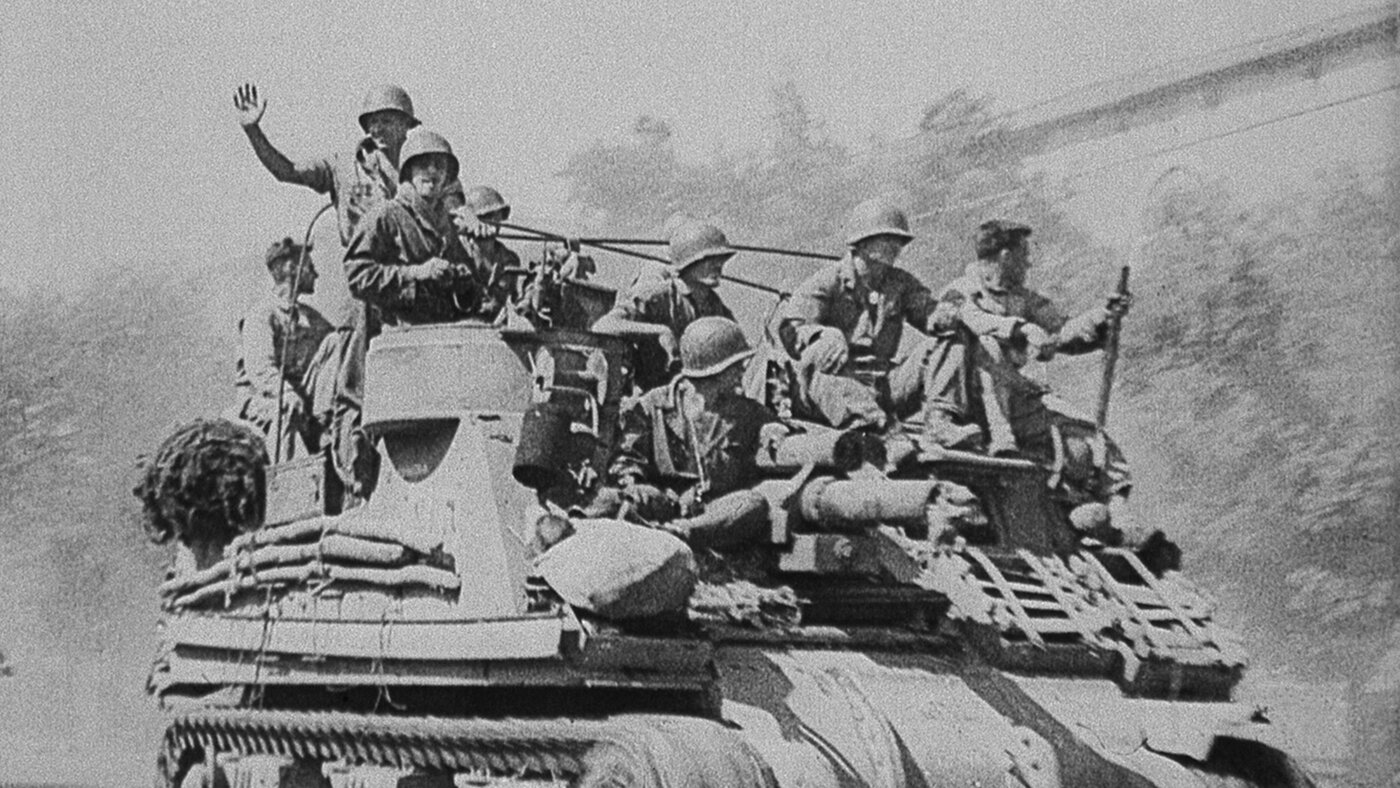
In the months after the Liberation and the fall of Fascism, Italian filmmakers insisted the camera confront the present head-on; filmmaker Alberto Lattuada summed up the mood in 1945: “We are in rags? Let’s show everyone our rags. We are defeated? Let’s look at our disasters.… Let’s pay all our debts with a ferocious love of honesty.”2 Allied authorities allowed such candor, enabling Rossellini to film amid still-smoldering ruins, enlist nonprofessional actors, and trust the camera to register facts that propaganda had suppressed. Post-surrender Japan, by contrast, found its film industry hemmed in by Occupation censorship. Pictures “infused with militarism,” that might provoke “the fanatic sense of loyalty the Japanese people had for the Emperor,” were verboten.3 Feudal legend offered directors a sanctioned way to work around these taboos. Mizoguchi’s choice of an eleventh-century folktale thus responds to a political constraint even as it draws on indigenous conventions; by relocating trauma into the distant past, he could probethe guilt of the violent war years without naming it directly. Under the pressure of national catastrophe, both Paisan and Sansho the Baliff produce two complementary ethics of cinematic duration—one grounded in documentary immediacy, the other in allegorical displacement—that oblige postwar audiences to witness suffering long enough to make meaning from it.
For Bazin, cinematic narrative centers on the unfolding “fact” rather than the shot; only the long take preserves the ambiguity of lived events and the freedom of the spectator to interpret them.4 Bazin identifies Paisan as the key work of post-Liberation Italian cinema, insisting that it “yields the most aesthetic secrets.”5 Location photography and nonprofessional actors bind fiction to freshly scarred Italian ground, while the camera’s patient observation refuses to sanitize devastation. Bazin published nothing on Sansho the Bailiff itself; his only comment on Mizoguchi comes in a letter from 1955, in which he groups the director with “the contemplative and mystical” vein of art.6 Yet Mizoguchi meets Bazin’s aesthetic of realism on its own terms: Like Rossellini, he lets the long take hold until its very duration carries the meaning. Though their formal signatures differ—the handheld, rough-hewn images of Paisan against the smooth lateral glides of Sansho—they converge on the same realist telos: an obligation to look.
***
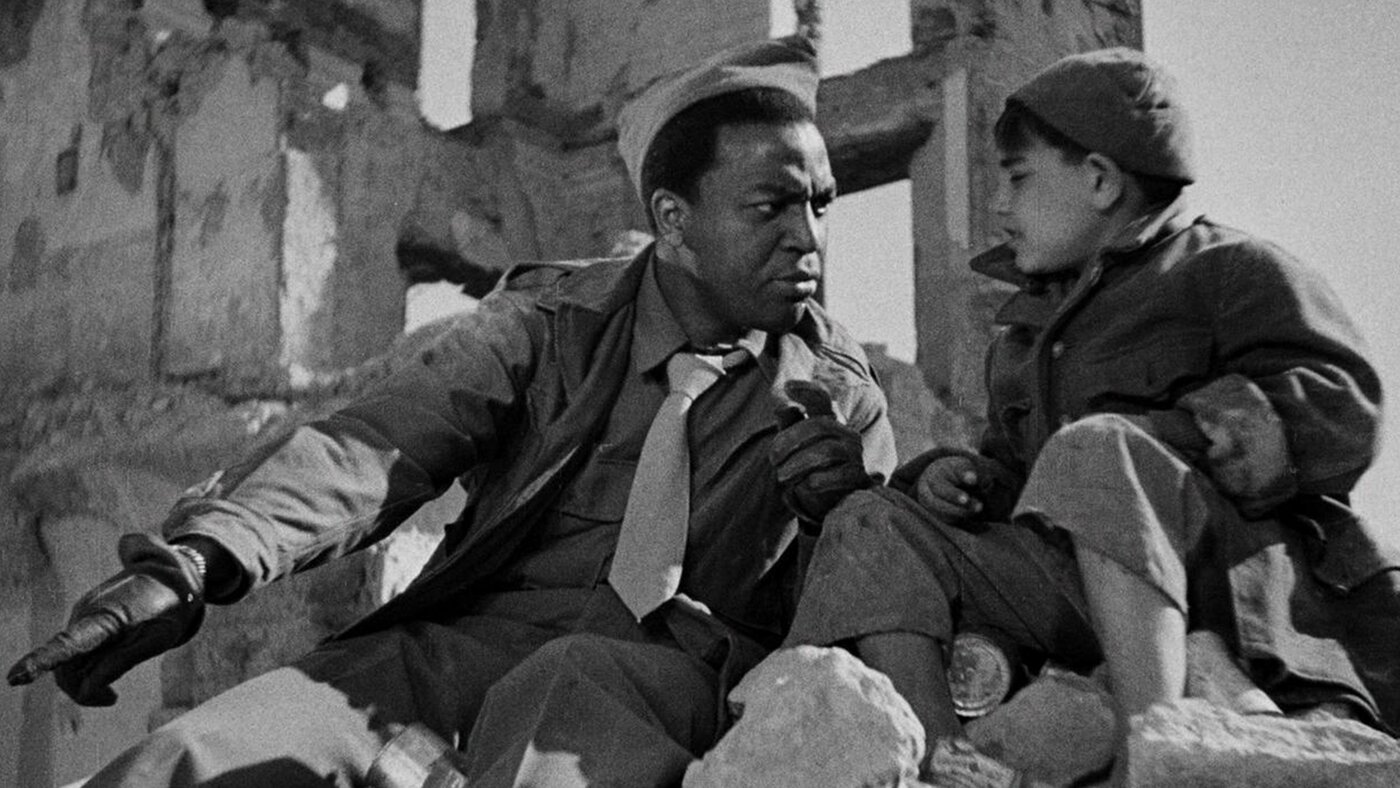
Paisan (Roberto Rossellini, 1946).
Paisan follows the Allied invasion of Italy from Sicily to Naples, then to the open city of Rome, and on to Florence and finally the Po delta. Eschewing a continuous combat narrative, Rossellini employs what Bazin calls the “image-fact,” fragments of concrete reality whose meaning emerges through lingering contemplation.7 The opening Sicilian episode mixes archival footage and staged fiction seamlessly. Here, documentary devastation and staged fiction will occupy a single evidentiary field. Long, mobile takes preserve these fragments in their spatial integrity, avoiding montage that might subordinate rubble to neat narrative closure.
Yet Rossellini insists devastation be experienced through estrangement, dislocation, and ellipsis. In Naples, a Black American military police officer, a stranger twice over, foreign to Italy and in his own segregated army, tails an orphan through bomb‑blasted markets to a cavern where children sleep on scavenged blankets. Florence intensifies the dislocation: A continuous traversal of the city under fire follows two English medics, guided by Italian partisans, the polyglot babel of the two groups underscoring the instability of any singular Italian voice. And nowhere does the Bazinian ellipsis bite harder than in the Po-delta finale. A peasant family who feeds partisan fighters is executed offscreen; the atrocity is communicated in three discontinuous shards: the shared meal between the Italians and the lone American at dusk, distant gunfire, and, at twilight, the tableau of corpses beside a crying infant. Bazin praises Rossellini’s audacity in leaving “great holes” that force the audience to leap imaginatively “as one crosses a river from stone to stone,” an aesthetic that reproduces wartime cognition, where events arrive piecemeal and moral sense trails behind perception.8 In the closing minutes of Paisan, the Germans shoot two captured Office of Strategic Services (OSS) officers, then bind stones to the ankles of their Italian comrades and tip them, one by one, into the water. The camera stays fixed on the rippling water, registering each splash. The river recovers quickly as it swallows the trace of the bodies—an indifferent landscape that, like history itself, absorbs evidence as quickly as it is made.
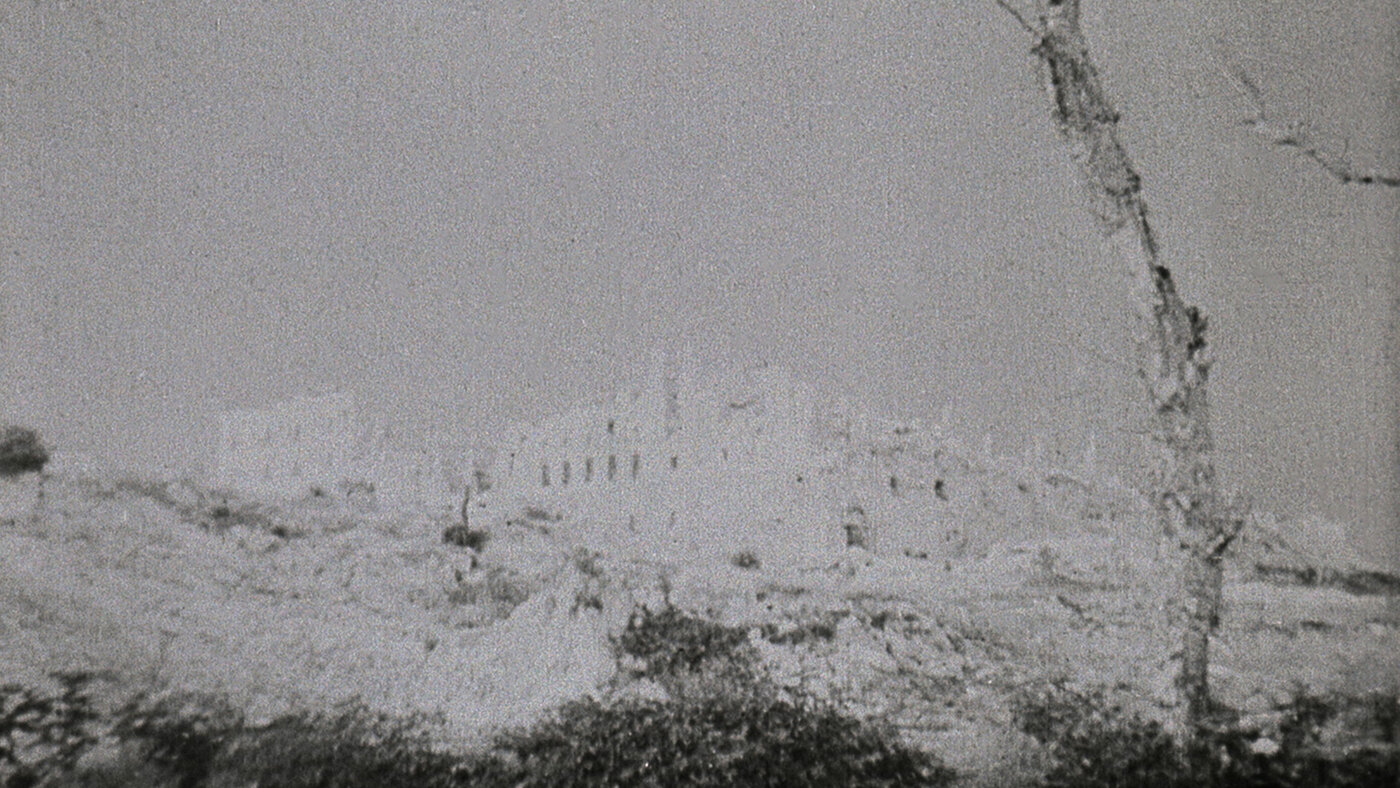
Paisan (Roberto Rossellini, 1946).
As it travels north, Paisan converts territory into testimony. The ruins retain the ambiguity of lived time; the shots’ duration grants them the right to speak before meaning is imposed. American soldiers, street urchins, monks, and partisans traverse the same desolate surfaces, yet no figure resolves the film’s moral quandaries. Instead, the spectator inherits the burden of interpretation—Bazin’s ethical horizon for cinematic realism. Because Rossellini filmed on the literal ruins of Fascist Italy, the film goes beyond simply depicting history: It houses it too.9
The American Occupation did more than demilitarize Japan; it hedged its imagination. “Any motion-picture treatment of the war which might revive nationalist sentiment” was forbidden.10 While Ozu and Kurosawa found latitude in contemporary family or crime narratives, Kenji Mizoguchi—steeped in jidai‑geki, Japan’s period‑drama tradition—sidestepped the same taboos in Sansho the Bailiff by adapting an eleventh-century folktale. If Rossellini filmed the ruins of Fascism in the present tense, Mizoguchi inscribed moral ruin in a historical age. Bazin’s touchstone is again duration: realism, he insists, lies not in contemporaneity but in “a cinema of ‘duration’,” the long take that lets facts breathe.11 Mizoguchi therefore composes his indictment through sustained shots that compel the spectator’s patience—that same obligation to look.
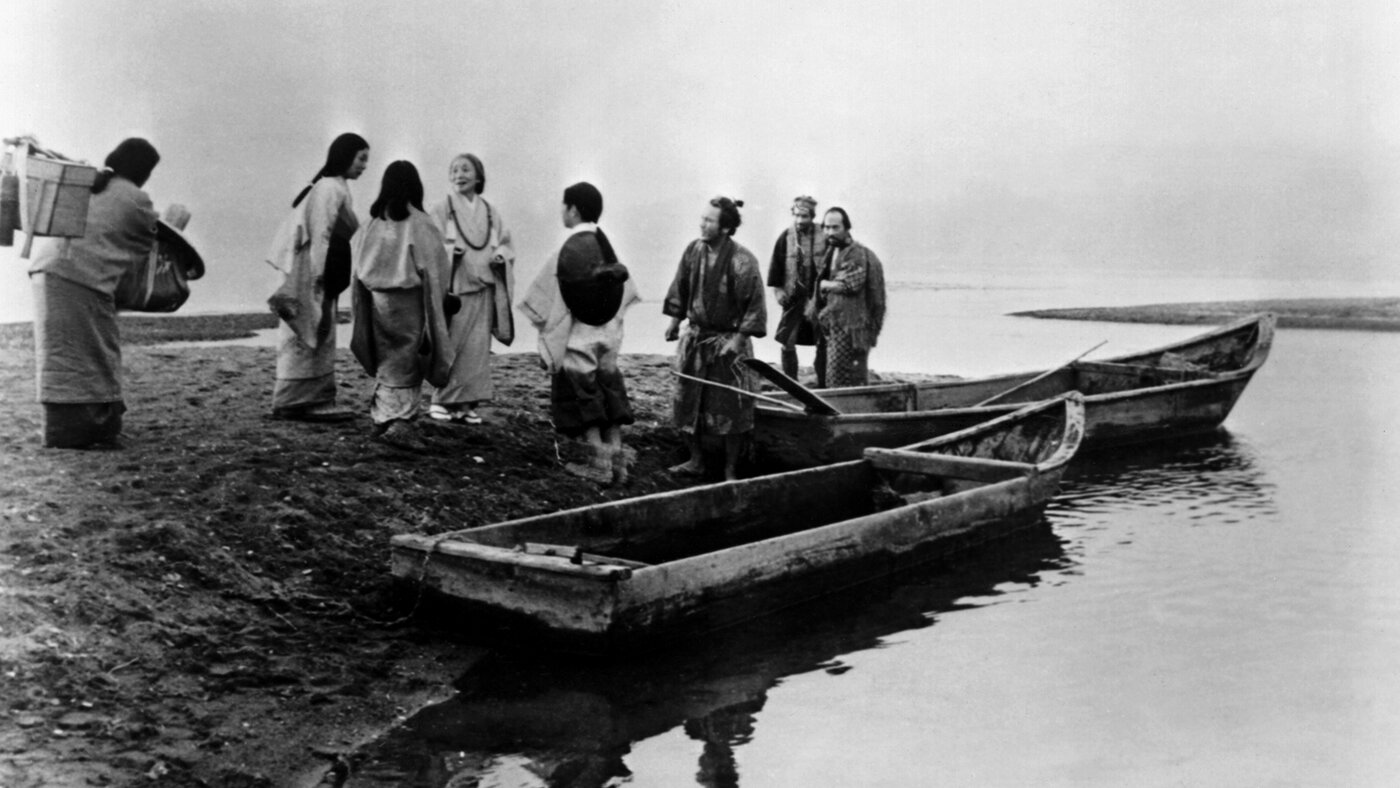
Sansho the Bailiff (Kenji Mizoguchi, 1954).
Sansho the Baliff tells of a family torn apart and a moral inheritance. A provincial governor, banished for shielding his peasants from a punishing military conscription, leaves his young son Zushiō with a parting creed: “Without mercy, man is like a beast. Even if you are hard on yourself, be merciful to others.” In the wake of this exile, the boy’s mother, Tamaki, is forced to set out with Zushiō and his sister, Anju, only for slave traders to trick them into separating. Tamaki is shipped to a brother on the distant island of Sado, and the children are sold into bondage on the estate of the notorious Sanshō.
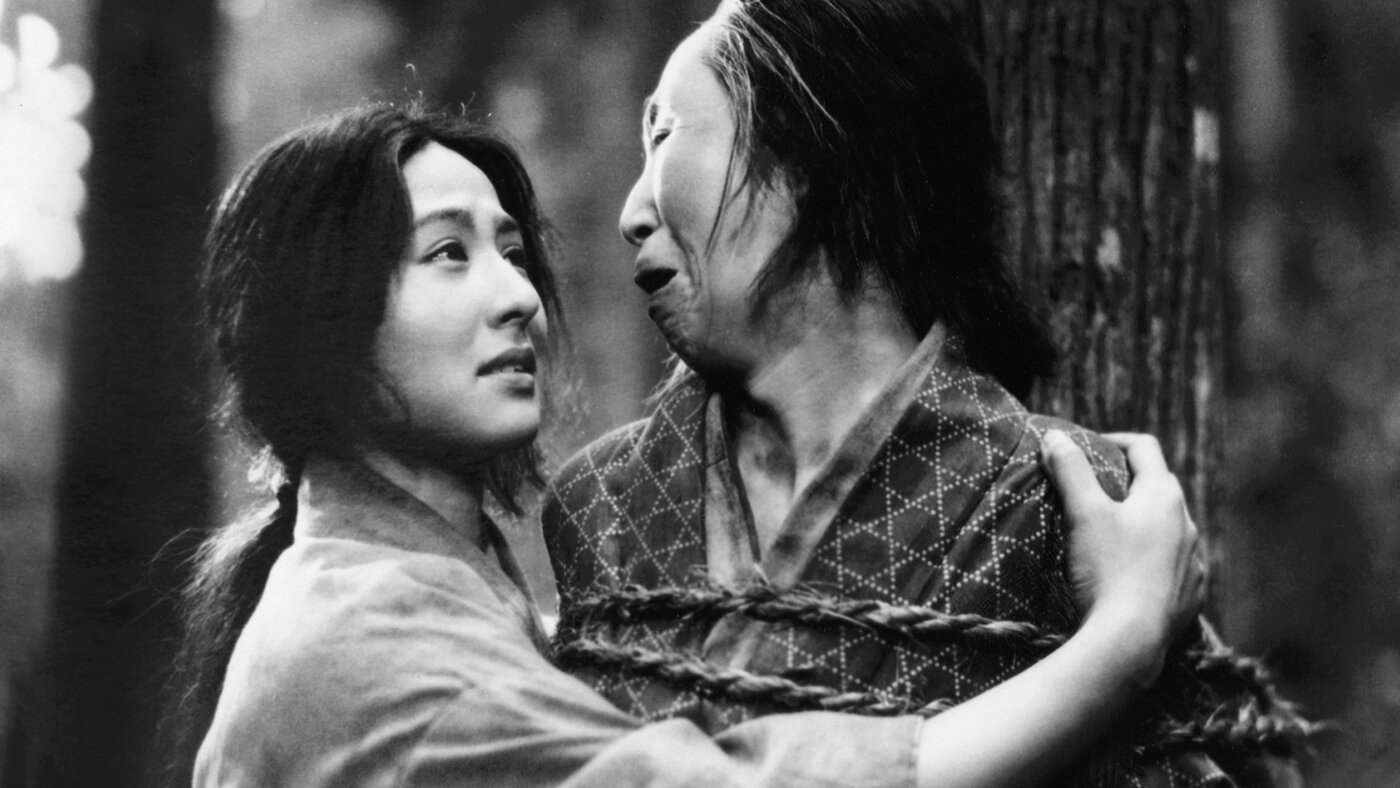
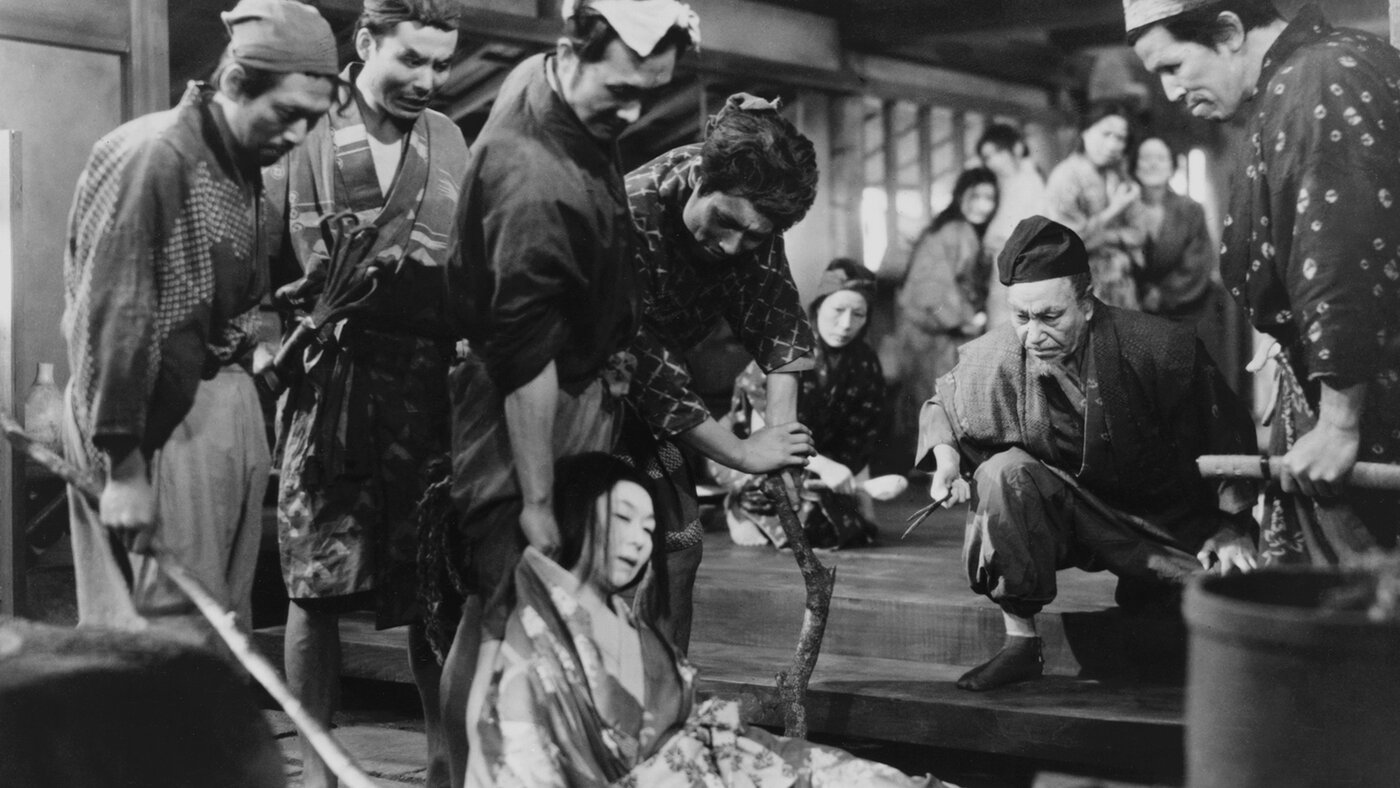
That pivotal kidnapping scene early in the film is rendered in a nervous series of shots. These shots alternate between shore, where Tamaki and her children are, and the boat that will carry them away, and are cut with mounting haste. The alternation compels viewers to shuttle between two doomed points of view, as the children are separated from their mother. Showing the family’s rupture across shots echoes Rossellini’s Po‑delta ellipses, though realized here through rhythmic oscillation instead of narrative gaps. What unsettles here is not duration but its denial: Mizoguchi cuts, fragmenting the family in the very form of the editing, and reserving the long, unbroken gaze for the suffering still to come. Later, Mizoguchi withholds from the viewer the graphic branding of a peasant in Sanshō’s slave camp. The lens tilts just high enough to conceal the burn itself, leaving only the peal of his screams and a plume of smoke. Mizoguchi trades detail for moral pressure. He forces us into the painful gap between intent and impact, much like Rossellini’s offscreen executions do, the withheld image makes us supply the violence ourselves. It is by imagining the burn that we stop watching and start participating. Another central moment, Anju’s suicide, is staged in near real time. As she descends into the pond, Mizoguchi refrains from showing struggle or overt dramatics; instead, he cuts elsewhere. Finally, the camera settles into stillness at the pond’s edge, capturing only the slowly diminishing ripples after Anju has vanished beneath the water’s surface. Here the realism of Mizoguchi’s cinema aligns fully with Bazin’s ethics of duration: The scene’s sustained pace compels viewers not merely to watch, but to keep watching. To see, here, is to be answerable.
Sansho the Bailiff (Kenji Mizoguchi, 1954).
Mizoguchi pushes Rossellini’s method one step further. Paisan points its camera at devastation while it is still raw, still smoking on the ground, Sansho the Bailiff sets the same cruelty in the distant past. That remove makes it endurable to watch, and that which we can watch, we can begin to judge. Both strategies, however, rest on Bazin’s conviction that “it is no longer the editing that selects what we see… it is the mind of the spectator which is forced to discern, as in a sort of parallelepiped of reality.”12 Censorship, not ethics, set Mizoguchi’s idiom apart from Rossellini’s. Where the neorealists could confront the ruins outright, he had to speak through legend. By obliging viewers to linger with suffering—the irreversible separation at the beach, the brand that sears both flesh and conscience, the prolonged farewell to innocence—Mizoguchi converts myth into a realist instrument. Allegory here neither consoles nor evades; it disciplines the gaze.
Beneath the dissimilar geography and chronology of Paisan and Sansho the Bailiff runs a lattice of shared preoccupations. Both hinge on elemental imagery that refuses consolation, enlists the spectator’s conscience through calculated manipulations of cinematic time, and balances blunt testimony with oblique parable. The unhurried depiction of a floating partisan corpse in the delta finale of Paisan finds its mirror in Anju’s suicide. In both works, water will not wash guilt away; it holds it, refusing to let it disperse.
Rossellini’s strategy is subtraction. He omits narrative links, so viewers must leap between shards of meaning. The gap is ethical: The viewer must complete the atrocity. Nothing onscreen assigns blame, so the work of understanding, and judging, falls to us. Mizoguchi accumulates instead. His long takes stretch experience until the spectator inhabits it somatically. Tamaki’s final recognition of Zushiō unfolds in real time, obliging the viewer to share the awkwardness of a decade’s guilt condensed into one embrace. Rossellini demands imaginative labor; Mizoguchi enforces empathetic endurance. Either way, viewers become custodians of sorrow.
Paisan (Roberto Rossellini, 1946).
Sound makes that grief resonate. Shot almost entirely without sound, Paisan was post-synced at Fono Roma, and its soundtrack, scuffed and hiss-filled, embraces these technical flaws to reflect the war’s acoustic debris. Each episode builds a distinctive sound world: Naples’ scooter engines and street urchins, Florence’s ricocheting sniper fire, the Apennine monks’ chant. Music is rare: Renzo Rossellini’s score surfaces only in terse bursts. Dialogue in Italian, English, Sicilian, German, and Latin, usually without subtitles, obliges the viewer to negotiate the very communicative impasses that divide the characters. Mizoguchi responds with silence. As Anju wades into the pond, only Tamaki’s distant lullaby—“Zushiō, Zushiō, how I long for you”—can be heard. When the shot ends, the song vanishes and the track collapses into near‑silence. Where Rossellini lets rough sound announce the world’s damage, Mizoguchi lets silence measure its cost; together the two directors ask the audience to hear what images alone cannot state.
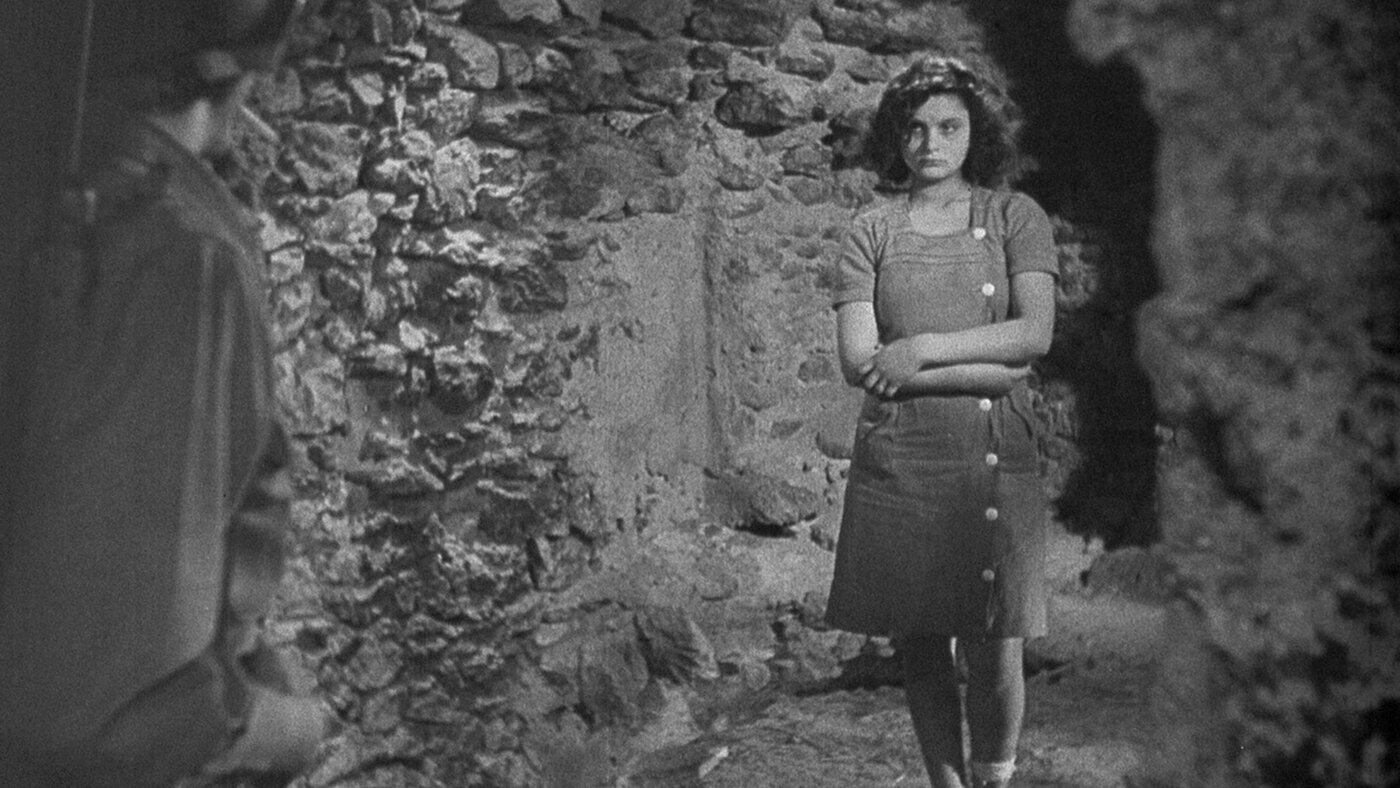
Women bear the moral weight of both films. In Paisan, Carmela’s offscreen killing in Sicily and the figure of the Roman sex worker Francesca—left behind, unrecognized by an American soldier who once loved her—anchor the episodic combat in the civilian cost of war. Mizoguchi casts that burden onto Tamaki and Anju. Tamaki’s lullaby drifts across Japan like a long‑range SOS. It is a single expression of maternal longing; the voice is powerless to act, yet it refuses to die. Anju answers it with action—freeing Zushiō and walking into the water. Her death becomes a counterpoint to Carmela’s broken body on the rocks. These women don’t wield arms or make policy, yet they absorb, embody, and pass judgment on national trauma. Their endurance turns spectacle into testimony.
Sansho the Bailiff (Kenji Mizoguchi, 1954).
The two films diverge, however, in how they choose to show suffering. Sansho the Baliff masks its critique in folktale; allegory kept the censors at bay but carried the risk of dilution. Mizoguchi counters by staging visceral setpieces—the branding and the drowning. Rossellini chooses the opposite hazard: unmediated actuality. The risk he runs is that his depiction of ruin will numb more than indict. His camera prowls real ruins, recruits locals, and welds news‑reel fragments to fiction. Only by showing the mangled present could Paisan purge the grandiose myths Fascism had spun. Whether through the veil of legend or the glare of immediacy, Rossellini and Mizoguchi ultimately converge on the same moral imperative: to make cinema a site where the nation beholds, without anesthesia, the cost of its own history—and, by that hard witness, begins the work of repair.
The censorship that shaped Sansho the Bailiff was not abstract. Kyoko Hirano documents how Occupation censors policed any image that might tie Japanese suffering to Allied firepower, noting that “no visual or verbal description of the devastation resulting from Allied attacks during the Pacific war was allowed.”13 In Hiroshi Shimizu’s Children of the Beehive (1948), for example, the orphan’s account of Hiroshima was stripped from the script and a panorama of the ruined city was swapped for “a less strikingly devastated scene,” lest the audience link the devastation to the American bomb.14 Hirano notes that allegory, then, was more a workaround than anything else. When the ripples of Anju’s drowning body dissolve into a Buddha, the shot fulfills what the censors themselves required:It sublimates the spectacle of suffering into spiritual transcendence, sidestepping the forbidden topic of Allied culpability while still letting the audience feel the wound.
Paisan (Roberto Rossellini, 1946).
Germany’s “rubble films” also photographed bombed cities, but often traded guilt for generalized sorrow. As Robert Shandley argues in Rubble Films, the Nazi past became “one problem among many.”15 Studio privilege helped. Germany’s Babelsberg survived intact, offering soundstages, lighting, and dubbing booths. Italy and Japan had no such refuge. Cinecittà became a refugee camp. Daiei Studios faced shortages. Rossellini and Mizoguchi had to shoot in open rubble and marsh. Their realism was dictated by the very real ruin of their respective nations.
Bazin argued that cinema embalms change, preserving time itself for later scrutiny.16 Yet in the rubble years after 1945, mummification was not enough. Film had to become a tribunal, a place where nations met their own reflection. Paisan and Sansho the Bailiff arrive by different roads—Rossellini through present-tense exposure, Mizoguchi through legendary proxy—but reach the same imperative: Make catastrophe last until it speaks. Duration becomes memory’s politics. Long takes let facts accuse. Gaps force the spectator to imagine what’s missing. When water closes over a partisan and, years later, over Anju, guilt is not washed away—it’s sealed in the viewer’s conscience. What begins as a realist device ends, paradoxically, in an ethical demand that exceeds realism.
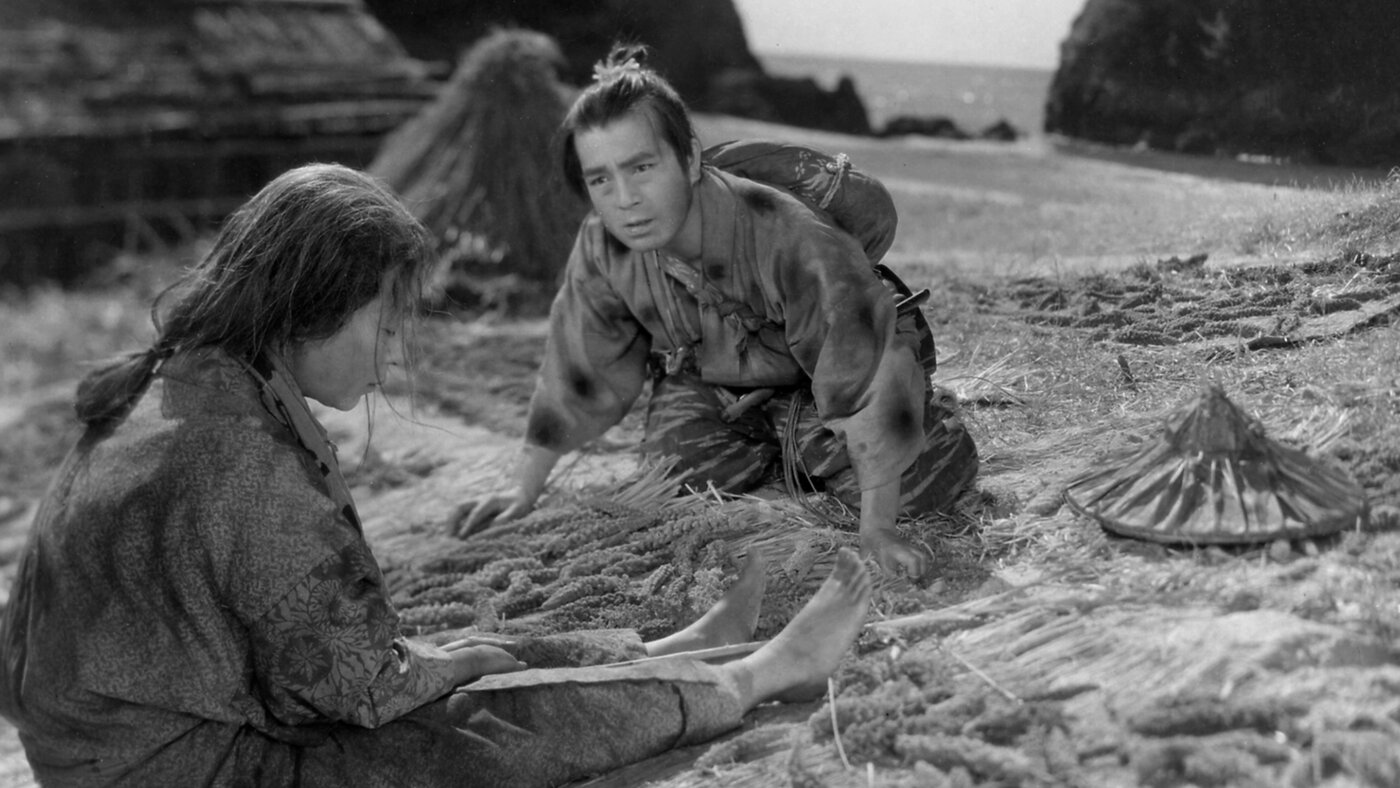
Sansho the Bailiff (Kenji Mizoguchi, 1954).
That demand has only sharpened. Eighty years on, rubble once again fills the screen—livestreamed strikes in Gaza, drone footage of shattered towers in Kharkiv, satellite vistas of scorched villages in West Darfur. These digital shards replay Rossellini’s “image‑facts” in real time, undigested and morally combustible. If Rossellini confronted Fascism’s collapse in open daylight and Mizoguchi displaced Japan’s trauma into mythic time, today’s citizen journalists deliver witness instantly, without any insulating scrim of legend or montage. Yet visibility alone never guarantees witnessing: As then, so now, attention must be disciplined.
Paisan and Sansho the Bailiff therefore belong not to a sealed postwar archive but to an ongoing ethics of looking. They remind us that catastrophe, once seen, imposes obligation. Anywhere the ground is filmed before it cools, we face the same choice their first audiences did: Turn away, or look long enough to reckon. Whether conveyed by long takes, narrative ellipses, or seven‑second clips, that same realist injunction persists: Having seen, we are answerable.
1. André Bazin, “An Aesthetic of Reality: Neorealism,” in What Is Cinema? Vol. 2, trans. Hugh Gray (University of California Press, 2005), 27.
2. Alberto Lattuada, quoted in Millicent Marcus, Italian Film in the Light of Neorealism (Princeton University Press, 1986), 26.
3. Isolde Standish, A New History of Japanese Cinema: A Century of Narrative Film (Continuum, 2005), 156–58.
4. Bazin, “An Aesthetic of Reality,” 36.
5. Bazin, “An Aesthetic of Reality,” 30.
6. André Bazin, letter quoted in Dudley Andrew, “Foreword to the 2004 Edition,” in What Is Cinema?, vi–vii.
7. Bazin, “An Aesthetic of Reality,” 32–40.
8. Bazin, “An Aesthetic of Reality,” 35.
9. Pierre Nora, “Between Memory and History: Les Lieux de Mémoire,” Representations 26, no. 26 (1989): 7.
10. Supreme Commander for the Allied Powers, Civil Information & Education Directive 49: Motion Picture Control, October 31, 1945.
11. André Bazin, “De Sica: Metteur en Scène,” in What Is Cinema? vol. 2, 76.
12. Bazin, “An Aesthetic of Reality,” 28.
13. Hirano, 54.
14. Kyoko Hirano, Mr. Smith Goes to Tokyo: Japanese Cinema under the American Occupation, 1945–1952 (Smithsonian Institution Press, 1992), 62–63.
15. Robert R. Shandley, Rubble Films: German Cinema in the Shadow of the Third Reich (Temple University Press, 2001), 47.
16. André Bazin, “The Ontology of the Photographic Image,” in What Is Cinema? vol. 1, trans. Hugh Gray (University of California Press, 1967.